Best overall depends on terrain. A fat tire e-bike that is excellent on snow may not be the best choice for steep climbing, and a powerful dual-motor model may be overkill for riders who mostly want comfort on rough pavement. The best fat tire e-bike is the one whose motor architecture, payload rating, suspension, battery and frame fit match the surfaces you actually ride.
For 2026, the strongest current WattWheelz options cover four different jobs: AWD traction, mid-drive climbing, high-capacity dual-motor riding and premium trail control. Browse the complete Fat Tire Bikes collection if you want to compare the full catalog, or compare the broader Electric Bikes collection if you are not yet committed to a fat tire platform.
Best Fat Tire E-Bikes 2026: Quick Picks
- Best AWD traction: EUNORAU Defender S 2.0 / Hunter X6.
- Best high-torque mid-drive: EUNORAU FAT-HD 2.0 / Hunter X7.
- Best dual-motor battery capacity: Freego Flash F3 Pro.
- Best premium trail package: Vanpowers Grand Teton Ultra.
- Best fat-tire family utility option: HappyRun G70.
Those are not ranked by one headline spec. They are ranked by the use case each platform is built to solve.
1. EUNORAU Defender S 2.0 / Hunter X6 — Best for AWD Traction
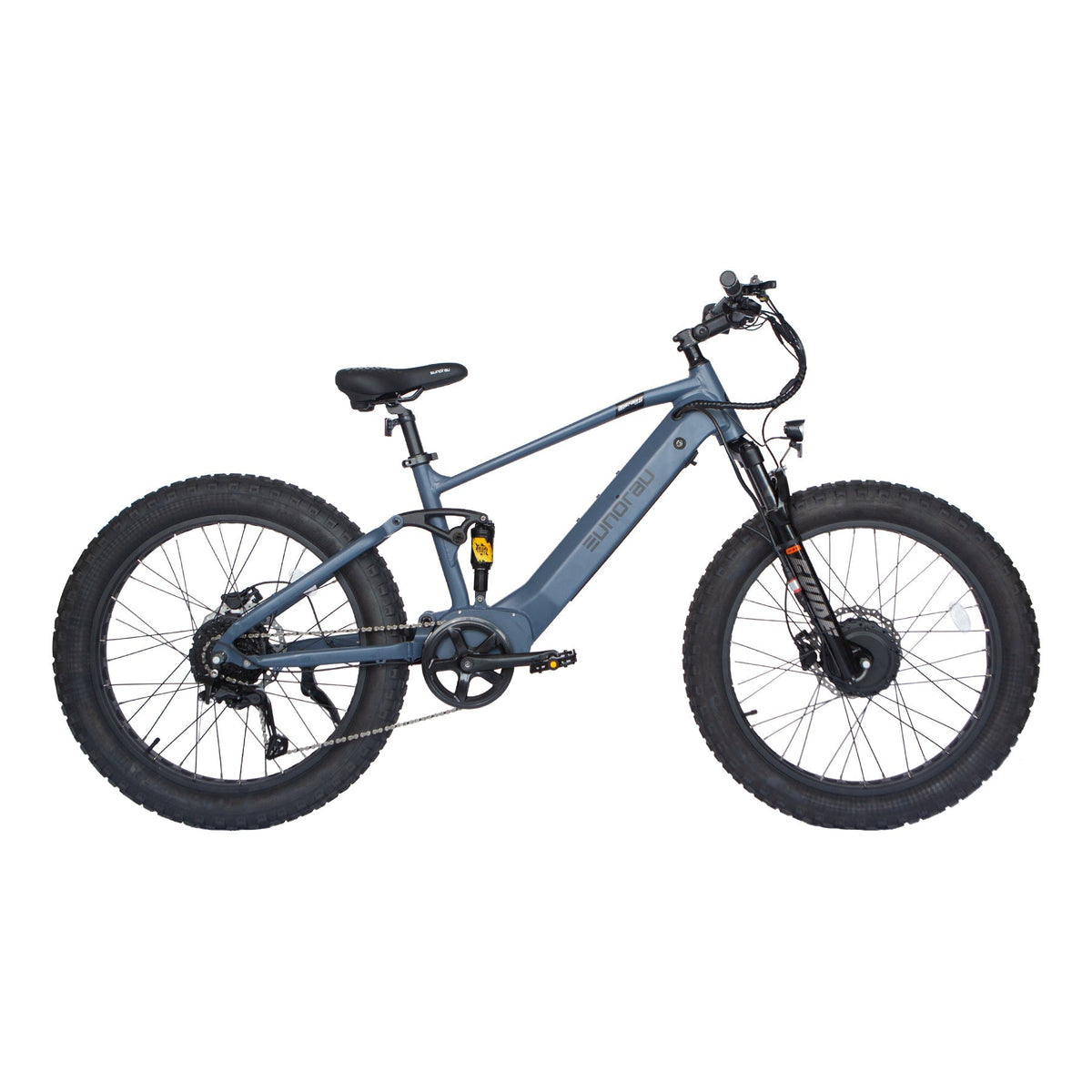
The Defender S 2.0 / Hunter X6 is the strongest fit when traction is the problem you are trying to solve. It uses dual 750W hub motors, 26 x 4-inch fat tires, torque-sensing pedal assist and four-bar full suspension. WattWheelz currently lists it at $2,799.
Its biggest advantage is having driven wheels at both ends. On loose dirt, snow, sand, wet grass and rutted access roads, that can help where a single driven wheel starts to spin. The tradeoff is weight and system complexity: AWD bikes are usually heavier, and two-motor acceleration can consume more battery when used aggressively.

Why the Defender S 2.0 Works for Snow and Loose Terrain
Fat tires create a wider contact patch, but tire width alone does not create unlimited grip. The Defender S 2.0 adds AWD, full suspension and large 203mm hydraulic rotors. That combination is valuable when the surface is changing underneath you rather than simply getting steeper. For a deeper look, read our Defender S 2.0 review.
2. EUNORAU FAT-HD 2.0 / Hunter X7 — Best for Mid-Drive Climbing
The FAT-HD 2.0 / Hunter X7 takes a different approach. Instead of two hub motors, it uses a 1,000W BAFANG mid-drive rated at 160 Nm. WattWheelz currently lists it at $2,799.
Mid-drive power goes through the bicycle drivetrain, so the rider can use lower gearing on steep climbs. That makes the FAT-HD 2.0 especially relevant for hunting access, long grades, loaded trail riding and riders who care more about controlled low-speed pulling force than two-wheel traction.

AWD vs Mid-Drive: Which Fat Tire Setup Is Better?
AWD and mid-drive solve different problems. AWD helps when the limiting factor is wheelspin. Mid-drive helps when the limiting factor is grade, gearing and sustained climbing. If your routes are loose and variable, AWD may be more useful. If your routes are steep but have reasonable traction, a strong mid-drive can be the smarter architecture.
We break that choice down in detail in AWD vs Mid-Drive E-Bikes.
3. Freego Flash F3 Pro — Best for Dual-Motor Power and Big Battery Capacity
The Freego Flash F3 Pro is the more moto-inspired pick. Its current WattWheelz listing publishes dual 750W nominal motors with up to 1,000W x 2 peak output, a 48V 40Ah battery and a 400 lb maximum load. Current price: $1,799.
That 1,920Wh battery is the key differentiator. Riders who use higher assist levels, carry more weight or cover longer mixed-surface rides often care as much about total battery energy as they do about peak motor output.

Who Should Choose the F3 Pro?
The F3 Pro fits riders who want aggressive styling, dual-motor acceleration, 20 x 4-inch tires and a large battery in one package. It is less traditional than the full-size 26-inch trail bikes above, so riders should compare seating position and handling preferences before ordering.
4. Vanpowers Grand Teton Ultra — Best Premium Trail Package
The Grand Teton Ultra is the most traditional mountain-bike-style option in this shortlist. It uses a mid-drive motor, 26 x 4-inch tires, an air suspension fork, four-piston hydraulic brakes, a dropper seatpost and a published 400 lb maximum load. WattWheelz currently lists it at $2,599.
This is the better fit for riders who care about trail control, component quality and a pedal-forward riding position more than maximum peak wattage.

5. HappyRun G70 — Best Fat-Tire Family Utility Pick
The HappyRun G70 combines 20 x 4-inch fat tires with family and cargo utility. It has a published 330 lb maximum load, dual-battery setup, rear passenger/cargo flexibility and full suspension. Current WattWheelz price: $1,299.
The G70 is not the choice for technical mountain-bike trails. It is the choice for riders who want the stability and comfort of a fat tire platform while carrying passengers, groceries or everyday gear.
What Fat Tires Actually Do
Fat tires increase tire volume and contact patch. On rough pavement, gravel, loose dirt, sand and snow, that can improve comfort and traction. They also allow riders to tune pressure more noticeably than narrow tires. Lower pressure can improve grip and compliance, while higher pressure generally rolls more efficiently on firm surfaces.
There are tradeoffs. Fat tires add rotating mass, can feel slower to accelerate and may create more rolling resistance. They are useful when your terrain justifies them, not because wider is automatically better.
Best Fat Tire E-Bike for Hills
For sustained steep climbing, the FAT-HD 2.0 stands out because its mid-drive can work through the bike's gearing and its published torque figure is high. The Grand Teton Ultra is another strong mid-drive choice for riders who want a more mountain-bike-oriented component package.
Best Fat Tire E-Bike for Snow
The Defender S 2.0 is the strongest snow-oriented pick here because AWD directly addresses traction loss. Tire pressure, tread, rider technique and snow depth still matter. AWD helps, but it does not turn an e-bike into a snowmobile.
Best Fat Tire E-Bike for Sand
For packed sand and mixed beach access, wide tires can be useful. AWD can help on softer sections, while a lighter or simpler bike may be easier to manage on firmer sand. Avoid assuming every beach or shoreline permits motorized e-bikes; local access rules control where you can ride.
Best Fat Tire E-Bike for Heavier Riders
Payload matters more than motor wattage here. The Freego F3 Pro and Grand Teton Ultra both publish 400 lb maximum-load figures, while the FAT-HD 2.0 publishes 375 lb. Payload typically includes the rider plus cargo and accessories, so the rider alone should not be assumed to equal the entire rating.
See our Best E-Bikes for Heavy Riders 2026 guide for the fit and capacity side of the decision.
Fat Tire E-Bike Range: What to Expect
Wide tires and heavier frames can consume more energy than lightweight commuter platforms, especially at higher speeds. Real-world range depends on battery watt-hours, rider and cargo weight, assist level, hills, temperature, wind, tire pressure and how often the throttle is used. Use published range figures as planning references rather than guaranteed distance.
What to Look for Before Buying
- Terrain: loose, steep, rough, or mostly paved?
- Drive system: AWD, hub motor, or mid-drive?
- Payload: rider plus cargo, not rider alone.
- Battery: compare watt-hours, not only voltage.
- Brakes: heavier bikes benefit from larger hydraulic systems.
- Fit: frame size, seat height and reach matter more than wheel width.
- Transport: many fat tire bikes are too heavy for standard bike racks.
Best Fat Tire E-Bike for Hunting and Backcountry Access
Hunting buyers should prioritize terrain before accessories. AWD is valuable when access roads are muddy, sandy or snowy. Mid-drive torque is valuable when the route is steep and loaded. Our Best Electric Bikes for Hunting 2026 guide compares those use cases directly.
Frequently Asked Questions
Are fat tire e-bikes better off-road?
They can be better on loose or rough surfaces because the wider tire provides more volume and a larger contact patch, but suspension, geometry, motor control and rider skill still matter.
Are fat tire e-bikes good in snow?
Yes, especially on packed or shallow snow when the tire tread, pressure and motor delivery are appropriate. Deep snow can still overwhelm an e-bike.
Is AWD better than a mid-drive?
Not universally. AWD is strongest when traction is the limiting factor; a mid-drive is strongest when gearing and steep sustained climbing are the limiting factors.
Do fat tires reduce range?
They can increase rolling resistance and weight, which may reduce efficiency compared with a lighter narrow-tire bike. Range still depends on many other variables.
What tire pressure should I use?
Use the tire and manufacturer guidance as your safe range, then adjust within that range for rider weight, terrain and comfort. Do not exceed the published tire limits.
Are fat tire e-bikes good for heavy riders?
Some are, but tire width alone does not determine capacity. Check the published total payload, frame fit, wheel construction and braking system.
Are 20-inch or 26-inch fat tires better?
20-inch wheels can lower the center of gravity and keep the bike compact. 26-inch wheels generally roll over obstacles more smoothly and feel more traditional on trails.
Do I need full suspension?
Not for every route. Full suspension matters more on rough trails and repeated impacts; paved and light-gravel riders may not need the added weight and complexity.
Can fat tire e-bikes go on beaches?
That depends on local rules and the specific beach. Packed sand is much easier than deep loose sand, and motorized access may be restricted.
Where should I compare fat tire e-bikes?
Start with the WattWheelz Fat Tire Bikes collection and compare terrain, fit, payload, battery and drive architecture before choosing.
Sources & Verification
Model specifications in this guide are reconciled against current WattWheelz product pages and current manufacturer-published specifications. Pricing, availability, configurations and performance claims can change. Range and speed figures are manufacturer estimates rather than WattWheelz guarantees.