AWD and mid-drive e-bikes are not competing versions of the same idea. AWD sends power to both wheels, usually through two hub motors. A mid-drive sends power through the bicycle drivetrain so the motor can take advantage of the bike's gears. Which is better depends on the problem your terrain creates.
If you lose traction on snow, sand, loose dirt or wet access roads, AWD can be the better tool. If your challenge is steep climbing, loaded riding or maintaining controlled torque through a long grade, a strong mid-drive can be more efficient and easier to manage.
AWD vs Mid-Drive: Quick Answer
- Choose AWD when loose terrain and wheelspin are the main problem.
- Choose mid-drive when steep grades, gearing and low-speed climbing are the main problem.
- Choose based on terrain first, not peak wattage.
Browse fat tire e-bikes or mountain e-bikes if you want to compare current platforms.
How AWD E-Bikes Work
Most AWD e-bikes use separate front and rear hub motors. When both are engaged, each wheel can contribute drive force. That is useful when one tire is on a lower-grip surface than the other or when soft terrain would cause a single driven wheel to spin.
The current EUNORAU Defender S 2.0 / Hunter X6, for example, uses dual 750W hub motors and 26 x 4-inch tires. WattWheelz currently lists it at $2,799.

How Mid-Drive E-Bikes Work
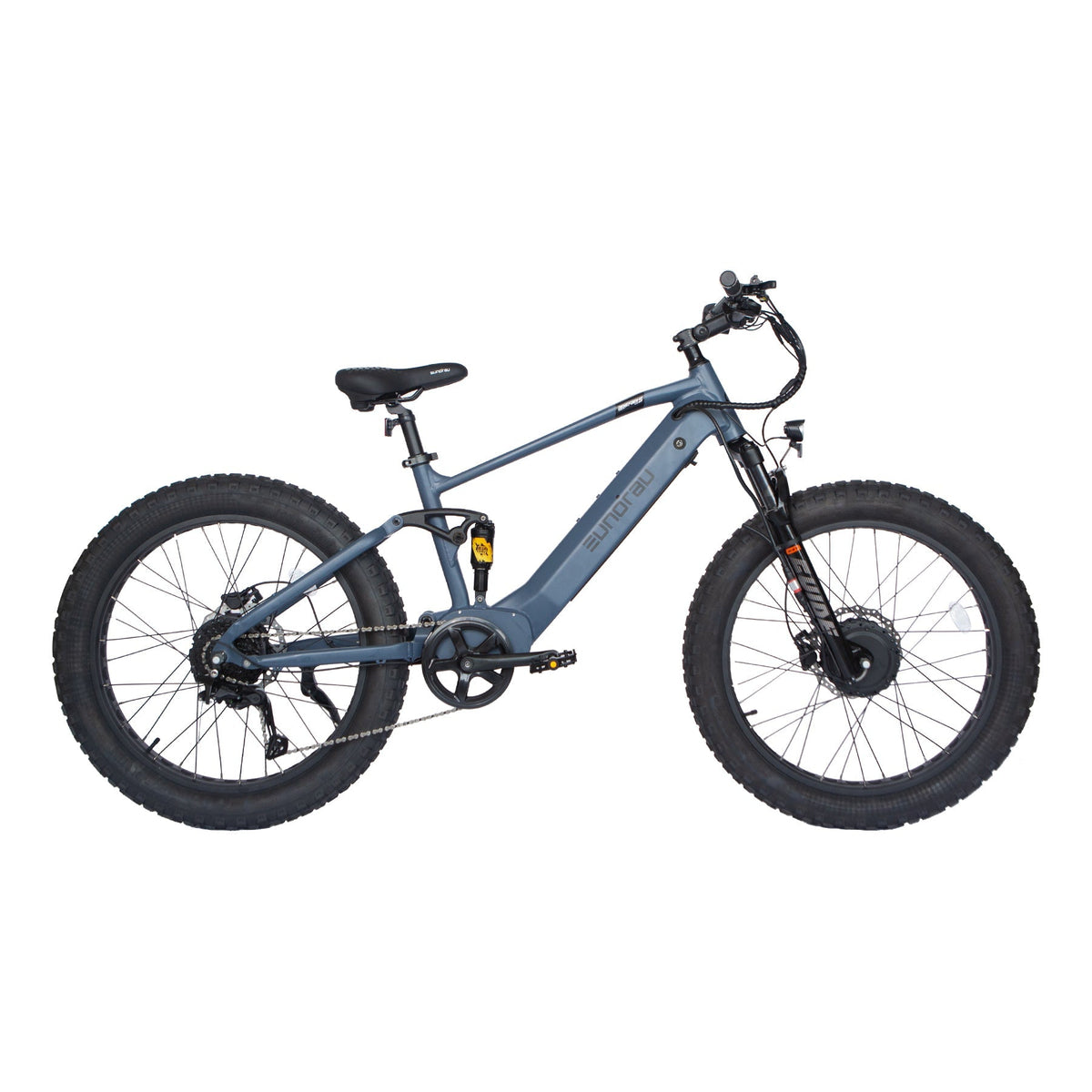
A mid-drive places the motor near the crank and sends power through the chain, cassette and rear wheel. Because the motor can use the bicycle's gears, the rider can shift into a lower gear on steep grades and keep the motor operating in a more useful range.
The EUNORAU FAT-HD 2.0 / Hunter X7 is a clear example. It uses a 1,000W BAFANG mid-drive with a published 160 Nm torque figure. Current WattWheelz price: $2,799.

Which Is Better for Hills?
For sustained steep climbing on surfaces with reasonable grip, mid-drive is usually the more logical architecture. The motor can use the bike's gearing rather than being locked into one hub reduction ratio. That gives the rider more control over cadence and low-speed torque.
AWD still has an advantage when the climb is loose. A steep gravel road can create both a gearing problem and a traction problem. In that situation, the second driven wheel can matter more than theoretical drivetrain efficiency.
Which Is Better for Snow?
AWD is generally the stronger snow choice because traction is often the limiting factor. Two driven wheels can help the bike continue moving when one tire starts to slip. Fat tire pressure, tread and rider technique still matter. AWD cannot overcome deep snow, ice or poor tires by itself.
Which Is Better for Sand?
On packed sand, both systems can work well with appropriate tires. On softer sand, AWD can help keep forward drive distributed across both wheels. Riders should reduce expectations as sand gets deeper because energy use rises quickly and steering can become difficult.
Which Is Better for Technical Trails?
Mid-drive systems often feel more natural on technical trails because power is concentrated near the center of the bike and the rider can use normal gearing. That can improve balance and make wheel handling more predictable. A well-designed AWD bike can still work very well on rough access roads and open trails, but front-hub weight can affect steering feel.
AWD Example: Defender S 2.0
The Defender S 2.0 combines AWD, torque sensing, full suspension, 203mm hydraulic rotors and 26 x 4-inch tires. Its current published payload is 300 lb including rider and cargo. The platform is best understood as a traction-first all-terrain machine rather than a lightweight mountain bike.
Read the full Defender S 2.0 review if this is the architecture you are considering.
AWD Example: Freego Flash F3 Pro
The Freego Flash F3 Pro takes a more moto-inspired approach with dual motors, 20 x 4-inch tires and a large 48V 40Ah battery. WattWheelz currently lists it at $1,799.
This is a good reminder that "AWD" does not describe one type of bike. The Defender is a full-size 26-inch trail/hunting platform, while the F3 Pro uses a compact, long-seat format with a much larger battery.

Mid-Drive Example: FAT-HD 2.0
The FAT-HD 2.0 is the heavy-duty fat tire mid-drive example. Its 160 Nm published torque, 26 x 4-inch tires, 375 lb payload rating and optional second battery make it relevant for hills, hunting access and loaded riding. Mid-drive buyers should understand that higher torque through the chain also means drivetrain wear matters more.
Mid-Drive Example: Grand Teton Ultra
The Vanpowers Grand Teton Ultra uses a 500W mid-drive with a published 130 Nm torque figure, a 400 lb maximum load, 26 x 4-inch tires, air suspension and four-piston hydraulic brakes. Current WattWheelz price: $2,599.
This is the more pedal-forward mid-drive choice for riders who prioritize mountain-bike components, controlled trail handling and a lower headline power number with strong torque.

Battery Efficiency: AWD vs Mid-Drive
There is no universal range winner because battery size, speed and riding behavior matter more than architecture alone. AWD can consume energy quickly when both motors are used hard. A mid-drive can be efficient on hills when the rider uses the correct gear, but aggressive high-assist riding can still drain the battery quickly.
Compare battery energy in watt-hours, not only voltage or amp-hours. A larger pack can offset a more power-hungry system, but it also adds weight.
Weight and Handling
Dual-motor AWD bikes add a second motor, wiring and controller hardware. That usually increases weight and can put more mass in the front wheel. Mid-drive systems centralize more of the powertrain mass near the crank, which can make the bike feel more balanced on technical terrain.
That does not make mid-drive automatically easier. High-torque mid-drives can still be heavy machines, especially when paired with fat tires and large batteries.
Maintenance Differences
Hub-motor AWD systems place less motor torque through the bicycle chain, but they add a second motor and additional electrical hardware. Mid-drives use the bike's chain and cassette to transmit motor torque, so chain, cassette and chainring condition matter more under high loads.
For riders who climb frequently, shifting technique becomes important on a mid-drive. Avoid forcing a shift under maximum motor torque whenever possible.
Braking and Control
Drive architecture does not reduce the need for good brakes. AWD bikes can accelerate hard, and loaded mid-drive bikes can build significant downhill speed. Large hydraulic rotors and properly maintained tires are critical on both platforms.
AWD vs Mid-Drive for Hunting
Hunters should choose based on access conditions. Mud, snow, sand and wet grass favor AWD. Steep but grippy logging roads favor mid-drive gearing. Payload, trailer compatibility, range and noise also matter. See our Best Electric Bikes for Hunting 2026 guide for model-specific picks.
AWD vs Mid-Drive for Heavier Riders
Do not use motor type as a substitute for payload capacity. A powerful AWD bike can still have a lower published payload than a lower-wattage mid-drive. Check total payload, rider-height fit, brake hardware, wheel build and tire pressure guidance independently.
Which One Should You Buy?
Choose AWD if your rides routinely involve loose surfaces where traction disappears before motor power does. Choose mid-drive if your routes are steep, loaded or technical and you want to use the bicycle's gearing. If you are still deciding, start with our Best Fat Tire E-Bikes 2026 guide and compare complete bikes instead of architecture in isolation.
Frequently Asked Questions
Is AWD better than mid-drive?
Only when your use case benefits from two driven wheels. Mid-drive can be better for steep climbing, balance and use of the bike's gearing.
Is AWD better in snow?
Usually, because it can distribute drive to both wheels. Tire tread, pressure and snow depth still determine whether the bike can maintain grip.
Is mid-drive better for hills?
It is often better for sustained steep grades because the motor can use the bicycle's lower gears.
Does AWD use more battery?
It can when both motors are used aggressively. Real range also depends on pack size, speed, terrain, temperature and rider weight.
Are mid-drives harder on chains?
Yes, motor torque passes through the chain and cassette, so drivetrain wear and shifting technique matter more.
Are AWD e-bikes heavier?
They often are because of the second motor, controller and wiring. Actual bike weight varies by model.
Which is better for sand?
AWD can help on soft or loose sand because both wheels contribute drive, but tire width, pressure and sand depth still matter.
Which is better for hunting?
AWD is strongest for poor traction; mid-drive is strongest for steep, loaded climbs. The route should determine the architecture.
Can a mid-drive have fat tires?
Yes. Models such as the FAT-HD 2.0 and Grand Teton Ultra combine mid-drive motors with 26 x 4-inch fat tires.
Where can I compare AWD and mid-drive models?
Browse the Fat Tire Bikes and Mountain collections at WattWheelz, then compare payload, battery, fit and terrain needs.
Sources & Verification
Specifications are reconciled against current WattWheelz product pages and manufacturer-published information for the models discussed. Prices, configurations, range and performance claims can change. Local laws and trail rules determine where specific e-bike configurations may be operated.