
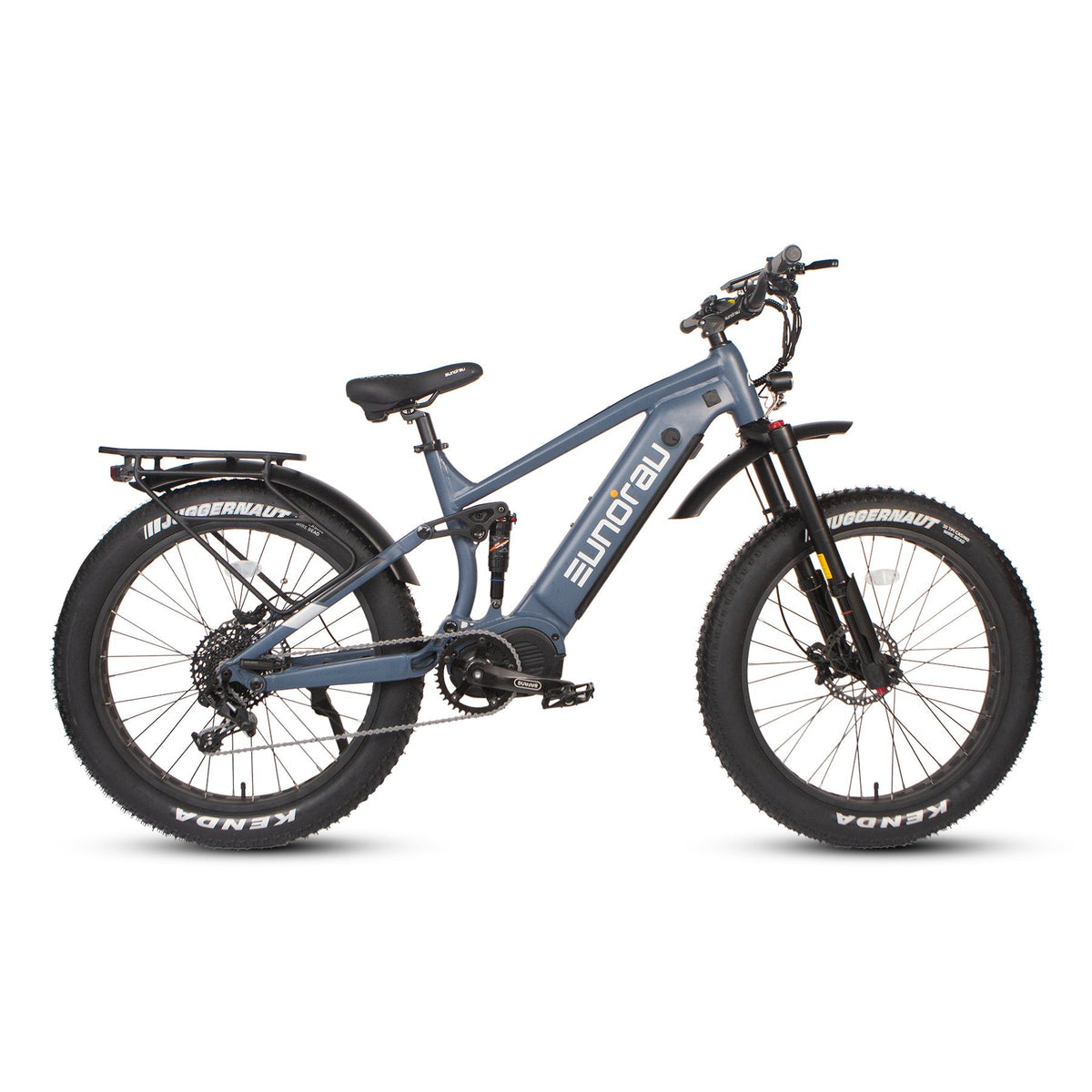
Short answer: the best electric bike for hunting is not simply the bike with the biggest motor. A serious hunting e-bike needs enough torque for loaded climbs, enough battery reserve for the ride back out, tires that work on the actual terrain, brakes that can control rider-plus-gear weight, and a frame that can accept the racks or trailer setup you intend to use. Just as important, the bike has to be legal on the roads or trails you plan to ride.
For 2026, WattWheelz has several hunting-oriented electric bikes that solve those problems in different ways. The five models in this guide were selected by buyer fit and current specifications, not from a claim that WattWheelz independently trail-tested every model against every competitor. Manufacturer range and performance figures are identified as published specifications rather than guaranteed real-world results.
The current shortlist spans high-torque mid-drives, dual-motor AWD bikes, full-suspension trail platforms and lower-cost utility-oriented options. If you already know the terrain, distance, payload and access rules for your hunting area, you can usually narrow the decision quickly.
Best Electric Bikes for Hunting in 2026: Quick Picks
| Model | Buyer-fit pick | Drive | Published range | Payload | Current price |
|---|---|---|---|---|---|
| Hunter X9 / SPECTER S 4.0 | Premium full-suspension mid-drive | 1,000W BAFANG mid-drive | Up to 40 mi standard / ~52 mi with optional secondary battery | 300 lb | $3,799 |
| Hunter X6 / Defender S 2.0 | AWD traction on loose terrain | Dual 750W hub motors | Up to 40 mi / up to 80 mi with optional second battery | 300 lb | $2,799 |
| Hunter X7 / FAT-HD 2.0 | High-torque climbing + payload | 1,000W BAFANG mid-drive, 160 Nm | Up to 80 mi with dual batteries | 375 lb | $2,399 |
| Hunter X8 / FAT-HS | Full suspension + long-range mid-drive | 1,000W BAFANG mid-drive, 160 Nm | Up to 80 mi with dual batteries | 300 lb | $3,449 |
| FAT-AWD 3.0 | Value-focused AWD + step-through access | Dual 500W hub motors | Up to 80 mi with dual batteries | 375 lb | $1,699 |
Important: published range varies with terrain, load, temperature, tire pressure, speed, throttle use and motor mode. Dual-battery maximums require the compatible second battery where noted.

What Actually Makes an E-Bike Good for Hunting?
A hunting e-bike is a transportation and hauling tool. The requirements are different from a normal commuter. A 15-mile pavement ride at steady speed is not the same problem as five miles of steep two-track with mud, a loaded pack and a trailer.
For most hunters, five factors matter most: torque, traction, usable range under load, payload/hauling setup, and legal access. Comfort and serviceability come next because the bike may be miles from the truck when something goes wrong.
Mid-Drive vs AWD: Which Is Better for Hunting?
A mid-drive sends motor power through the bicycle drivetrain. That allows the motor to take advantage of the bike's gearing, which can be especially useful on steep grades and at lower speeds. The Hunter X9, Hunter X7 and Hunter X8 use high-output BAFANG mid-drive systems.
Dual-motor AWD bikes instead power both wheels. Their main advantage is traction: when one tire starts to slip on loose dirt, sand, snow or mud, the other driven wheel can help keep the bike moving. The Hunter X6 and FAT-AWD 3.0 use front-and-rear hub motors.
Neither architecture is automatically superior. Choose mid-drive when sustained climbing, gearing and loaded low-speed torque are the priority. Choose AWD when loose-surface traction and all-season grip matter more.
How Much Motor Power Does a Hunting E-Bike Need?
Power should be matched to terrain and access rules. A 750W-class bike can be enough for rolling terrain, while a 1,000W mid-drive can make sense for steeper private-land or motorized-route use. Dual-motor systems can add traction and acceleration, but they also increase battery consumption when both motors are used aggressively.
Do not shop by wattage alone. A high-torque mid-drive in the correct gear can outperform a higher combined hub-motor figure on a very steep loaded climb. Conversely, AWD can outperform a single driven wheel when traction—not torque—is the limiting factor.
How Much Range Do You Really Need?
The ride into the woods is only half the trip. A hunting e-bike needs reserve for detours, scouting, elevation gain, cold weather and the loaded ride back. If the manufacturer publishes 40 miles, do not build a 39-mile hunting plan around that number.
For remote use, a conservative planning rule is more useful: know your normal round-trip distance, then leave meaningful battery reserve instead of planning around the maximum claim. Optional dual-battery systems can be especially valuable because hunting loads and low-speed climbing can reduce efficiency.
Payload, Racks and Trailers: The Part Buyers Underestimate
Payload ratings include the rider and carried cargo. A 300 lb payload rating does not mean a rear rack can hold 300 lb. Racks, baskets, trailers and hitches have their own limits.
For game retrieval and heavy gear, trailer compatibility can matter more than another 10 mph of top speed. A bike that climbs predictably at low speed, stops confidently under load and accepts a proper trailer is often more useful in the field than a lighter recreational e-bike with a higher headline speed.
1. EUNORAU SPECTER S 4.0 / Hunter X9 — Premium Full-Suspension Mid-Drive Pick
The EUNORAU SPECTER S 4.0 / Hunter X9 is the most premium current hunting-specific platform in this WattWheelz shortlist. It combines a 48V 1,000W BAFANG G510 mid-drive, 48V 17.5Ah main battery, 140mm front suspension, rear suspension, 26 × 4-inch fat tires, SRAM NX 11-speed gearing and four-piston hydraulic brakes.
EUNORAU publishes up to 40 miles on the standard battery and approximately 52 miles when paired with the optional 48V 5Ah secondary battery. The current WattWheelz listing publishes a 300 lb maximum payload and an approximately 83.7 lb bike weight.
Why it fits hunting: the mid-drive can use the 11-speed drivetrain on climbs, full suspension helps when access roads turn rough, and four-piston brakes add control when descending with gear. This is the strongest fit for a hunter who wants a more premium trail-bike feel rather than maximum payload or the lowest price.
2. EUNORAU Defender S 2.0 / Hunter X6 — AWD Traction Pick
The Defender S 2.0 / Hunter X6 uses dual 48V 750W hub motors for 1,500W combined rated output, torque-sensing pedal assist, four-bar full suspension and 26 × 4-inch fat tires.
The included 48V 17Ah battery carries an up-to-40-mile manufacturer range figure, while a compatible optional second-battery setup can extend the published maximum to 80 miles. WattWheelz lists a 300 lb payload and approximately 89.3 lb bike weight.
Why it fits hunting: AWD is most valuable when traction is inconsistent—loose dirt, wet ground, snow, sand and rutted access roads. If your hunting property regularly creates wheelspin rather than simply steep climbing, the X6 architecture deserves a close look.

3. EUNORAU FAT-HD 2.0 / Hunter X7 — High-Torque Payload Pick
The FAT-HD 2.0 / Hunter X7 pairs a 1,000W BAFANG mid-drive with 160 Nm of published torque, a 48V 15Ah Samsung-cell battery, 26 × 4-inch tires, hydraulic disc brakes and a 375 lb published payload rating.
An optional second 15Ah battery enables EUNORAU's up-to-80-mile maximum range claim under favorable conditions. At roughly 81.6 lb, the X7 is substantial but carries more published payload than the X9 or X6.
Why it fits hunting: this is the practical torque-and-payload option. A 160 Nm mid-drive can use the gearing when climbing slowly under load, while the 375 lb payload creates more headroom for a heavier rider plus hunting gear.

4. EUNORAU FAT-HS / Hunter X8 — Full-Suspension Long-Range Mid-Drive Pick
The FAT-HS / Hunter X8 combines a 1,000W BAFANG M615 mid-drive, 160 Nm of published torque, full suspension and 26 × 4-inch fat tires. EUNORAU publishes up to 80 miles with a dual-battery configuration.
The X8's strongest distinction versus the X7 is suspension. If the access route is rough enough that rider fatigue and chassis control matter as much as payload, full suspension can justify the added cost. The current bike weighs roughly 77–79 lb depending on published configuration details.
Why it fits hunting: it combines the low-speed climbing advantage of a high-torque mid-drive with full suspension and optional long-range battery capacity. That is a strong combination for long, rough backcountry access where comfort affects how fresh you feel when you arrive.

5. EUNORAU FAT-AWD 3.0 — Value AWD + Step-Through Pick
The FAT-AWD 3.0 uses dual 500W hub motors, selectable front/rear/dual-motor assistance, a 48V 15Ah LG-cell battery, 26 × 4-inch tires and a 375 lb payload rating.
The optional second 15Ah battery enables an up-to-80-mile manufacturer range claim. Its current WattWheelz price is substantially lower than the premium mid-drive and full-suspension hunting models in this guide, while the step-through frame can make mounting easier when wearing bulky gear.
Why it fits hunting: buyers who want AWD traction, high published payload and a lower entry price can get those fundamentals without moving into the more expensive Hunter X6. The tradeoff is that the FAT-AWD 3.0 uses front suspension rather than full suspension and hub motors rather than a mid-drive.

Which Hunting E-Bike Should You Choose?
Use the terrain and job to narrow the list:
- Steep, technical climbs: start with a high-torque mid-drive such as Hunter X7 or Hunter X8.
- Loose snow, mud, sand or changing traction: start with an AWD option such as Hunter X6 or FAT-AWD 3.0.
- Premium rough-trail handling: Hunter X9 combines mid-drive power, full suspension and higher-end drivetrain/braking hardware.
- Heavier rider + gear: look closely at the 375 lb published payload on Hunter X7 and FAT-AWD 3.0.
- Long outings: prioritize the dual-battery-capable X6, X7, X8 or FAT-AWD 3.0 and plan conservatively around real terrain.
Can You Use a Hunting E-Bike on Public Land?
Do not assume that a bike marketed as a hunting e-bike is legal on every hunting road or trail. Land-manager rules, state hunting regulations and local route designations can all matter.
The Bureau of Land Management currently defines an e-bike as a bicycle with fully operable pedals and a motor of no more than 750 watts that fits within Class 1, 2 or 3 parameters. BLM's FAQ states that electric vehicles above 750W or providing assistance above 28 mph fall outside that e-bike definition and are managed as off-highway vehicles under BLM rules.
That distinction matters because several bikes in this guide use 1,000W or greater systems. Even if a display or controller can be speed-limited, wattage and the land manager's specific rule can still affect classification.
What About National Forests?
Forest Service guidance generally allows Class 1, 2 and 3 e-bikes on National Forest System roads and trails already open to motorized use, while local units can consider additional e-bike designations on certain non-motorized routes. Access is route-specific.
Before a hunt, check the current Motor Vehicle Use Map or Interactive Visitor Map for the exact forest or district, then separately confirm state wildlife-agency rules for hunting access and motorized travel. Regulations can change, and a legal riding route does not automatically mean every hunting activity from that route is permitted.
Do Electric Bikes Spook Deer?
An electric bike eliminates the engine noise and exhaust of a gas ATV, but it is not silent. Tires, chain, suspension, brakes and the motor still make noise. The practical advantage is lower acoustic and scent disturbance compared with many combustion vehicles, especially when moving slowly.
The best approach near a hunting area is still to reduce speed, avoid unnecessary acceleration and stop short of the final approach rather than expecting the bike to be invisible to wildlife.
Do You Need Fat Tires for Hunting?
Not every hunter needs 4-inch tires, but fat tires are useful when the route includes sand, snow, soft dirt, loose gravel or rutted two-track. Their larger contact patch can increase flotation and traction.
The tradeoff is weight and rolling resistance. If your access is mostly hard-packed road, a narrower tire can be more efficient. For mixed backcountry surfaces, 26 × 4-inch platforms remain popular because they trade some efficiency for versatility.
Should You Add a Hunting Trailer?
A trailer can transform an e-bike from personal transportation into a true hauling system. It can carry stands, packs, coolers or game without putting all of the weight on the bicycle frame.
Trailer use increases rolling resistance, braking distance and battery consumption. Verify hitch compatibility and trailer load ratings, and leave more range reserve than you would for an unloaded ride.
Hunting E-Bike FAQ
What is the best type of electric bike for hunting?
For steep loaded climbs, a high-torque mid-drive is often the strongest fit because it can use the bicycle's gearing. For loose terrain where wheelspin is the bigger problem, dual-motor AWD can be more useful. The best architecture depends on terrain and legal access.
Is a mid-drive or dual-motor e-bike better for hunting?
Mid-drives are strong for low-speed climbing and efficient use of gearing. Dual-motor bikes add front-and-rear traction. Choose based on whether your hardest problem is grade or grip.
How much range should a hunting e-bike have?
Plan from your real round-trip distance and leave meaningful reserve. Do not plan around the maximum manufacturer range because hills, cold temperatures, trailers, rider weight and repeated throttle use can materially reduce range.
Can you haul a deer with an electric bike?
A properly rated hunting trailer can be used to haul game or gear, but the bike, hitch and trailer each have separate capacity limits. Loaded climbing, braking and battery range must also be considered.
Are 1,000W hunting e-bikes legal on BLM trails?
BLM's current e-bike definition is limited to motors of no more than 750W and Class 1, 2 or 3 parameters. BLM states that higher-wattage electric vehicles fall outside that e-bike definition and are managed under OHV rules. Check the exact route and local BLM office before riding.
Can I hunt from an e-bike?
Hunting-method and motorized-access rules vary by state, species, land manager and unit. A route being open to an e-bike does not automatically authorize every hunting activity from the bike. Check the current wildlife-agency and land-manager regulations for your hunt.
Are hunting e-bikes quiet?
They are generally much quieter than gas-powered ATVs, but not silent. Motor whine, tires, drivetrain, brakes and suspension still create sound.
Do hunting e-bikes need full suspension?
No. Full suspension improves comfort and control on rough terrain, while a hardtail or front-suspension bike can be simpler, lighter and more efficient on smoother access roads.
Is AWD worth it on a hunting e-bike?
AWD can be valuable in snow, sand, mud and loose climbs because both wheels can contribute traction. On firm terrain, a single high-torque mid-drive may be more efficient and mechanically simpler.
What payload capacity should a hunting e-bike have?
Add rider weight, clothing, pack and anything carried on the bike. If that total approaches the bike's published payload limit, choose a platform with more headroom. Remember that rack and trailer limits are separate.
What is the best hunting e-bike for heavy riders?
In this WattWheelz shortlist, the FAT-HD 2.0 / Hunter X7 and FAT-AWD 3.0 each publish a 375 lb payload rating, providing more rider-plus-gear headroom than the 300 lb-rated Hunter X9, X6 and X8.
Bottom Line
The right hunting e-bike should disappear into the job. It should climb the access road without overheating the rider, carry enough battery for the return trip, maintain traction when the ground changes, and support the gear or trailer setup you actually use.
For 2026, WattWheelz's current hunting-oriented lineup covers several distinct needs: the Hunter X9 for premium full-suspension mid-drive performance, Hunter X6 for AWD traction, Hunter X7 for high-torque payload work, Hunter X8 for full-suspension long-range mid-drive use, and FAT-AWD 3.0 for value-focused AWD utility.
Before buying, confirm the bike's current configuration and the rules where you hunt. If you want help matching terrain, rider weight, range and hauling needs to a specific setup, compare the live product pages or contact WattWheelz for model-specific guidance.
Keep researching: Browse the EUNORAU collection and fat-tire e-bike collection, then read our guide to hunting with electric dirt bikes and Best EUNORAU Electric Bikes of 2026.
Sources & Verification
- WattWheelz Hunter X9 / SPECTER S 4.0 — current dealer specifications, configurations and price.
- WattWheelz Hunter X6 / Defender S 2.0 — current dealer specifications, configurations and price.
- WattWheelz Hunter X7 / FAT-HD 2.0 — current dealer specifications, payload, range and price.
- WattWheelz Hunter X8 / FAT-HS — current dealer specifications, full-suspension layout, range and price.
- WattWheelz FAT-AWD 3.0 — current dealer specifications, AWD system, payload and price.
- EUNORAU Hunter X9 official page — manufacturer specifications and current-generation positioning.
- EUNORAU Hunter X6 official page — manufacturer AWD, battery and range specifications.
- EUNORAU Hunter X7 official page — manufacturer mid-drive, torque, payload and dual-battery specifications.
- EUNORAU Hunter X8 official page — manufacturer mid-drive, suspension and range specifications.
- Bureau of Land Management — E-Bikes on Public Lands — current federal e-bike definition and access guidance.
- BLM E-Bike FAQ — class definitions and treatment of vehicles above 750W or 28 mph.
- U.S. Forest Service Interactive Visitor Map service — route-level e-bike travel-opportunity data.
- Outdoor Life 2026 Hunting E-Bike Guide — independent category context and field-testing perspective.


