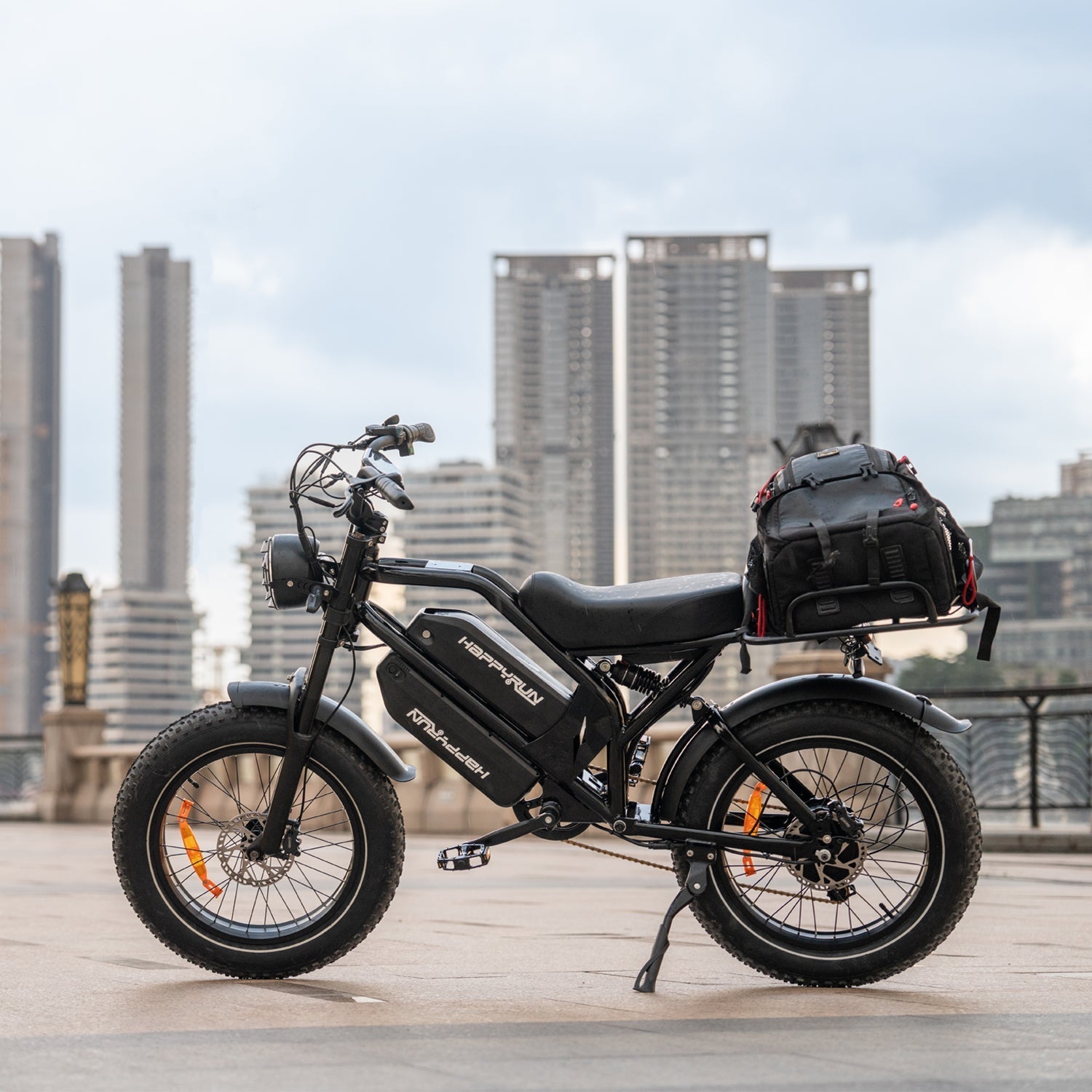
If you are comparing the HappyRun G70 vs G60 Pro, the decision is less about which bike has the bigger headline number and more about what job you need the bike to do. Both are fat-tire, full-suspension HappyRun models with hydraulic brakes, throttle assistance and strong utility value, but they are built around different priorities.
The G70 is the more cargo-oriented platform. It uses a longer utility layout, a removable rear passenger seat, dual-battery architecture on current manufacturer documentation, and a rear rack rated for practical hauling. The G60 Pro is the more compact moped-style option, with a shorter footprint, lower purchase price and a simpler single-battery layout.
There is also an important reason this comparison needs more care than a normal spec-sheet article: current WattWheelz listings and current HappyRun manufacturer pages do not fully agree on the exact power, battery and top-speed configuration for either bike. Rather than hiding that, this guide separates the verified shared features from the configuration-dependent claims so you can make a more informed purchase.
HappyRun G70 vs G60 Pro: Quick Verdict
Choose the HappyRun G70 if your priority is carrying a passenger or gear, maximizing practical utility, using a longer cargo-style frame, and getting the longest published range of the two. The G70 is the stronger family, hauling and mixed-purpose choice.
Choose the HappyRun G60 Pro if you want a more compact moped-style bike, lower current entry price, slightly lower weight, and you do not need the G70's rear-passenger/cargo layout. The G60 Pro makes more sense for solo riding, commuting and general-purpose use where cargo capacity is secondary.
Current WattWheelz pricing can change, so use the live product pages for the final decision: HappyRun G70 and HappyRun G60 Pro.
At-a-Glance Comparison
| Category | HappyRun G70 | HappyRun G60 Pro |
|---|---|---|
| Best for | Cargo, family rides, passenger use, utility | Solo riding, commuting, compact moped-style use |
| Current WattWheelz price | $1,299.00 | $1,099.00 |
| Published max range | Up to 85 miles | 70+ miles manufacturer / up to 80 miles WattWheelz listing |
| Bike weight | 98 lb manufacturer-published | 93 lb manufacturer-published |
| Payload | 330 lb | 330 lb |
| Rear rack load | 50 lb | 33 lb |
| Seat height | 32 in manufacturer spec | 34 in manufacturer spec |
| Tires | 20 x 4 in fat tires | 20 x 4 in fat tires |
| Brakes | Front/rear hydraulic, 160 mm rotors | Front/rear hydraulic, 160 mm rotors |
| Suspension | Full suspension | Full suspension |
Specification note: exact motor rating, battery capacity and top-speed configuration currently differ between WattWheelz and HappyRun's official product pages. Those differences are explained below instead of being blended into a single unsupported number.

The Biggest Difference: Cargo Utility vs Compact Versatility
The G70's strongest reason to exist is utility. It has a longer cargo-style layout and a removable rear seat that can be replaced with a cargo rack. HappyRun currently publishes a 50-lb rear-rack capacity, which is meaningfully higher than the G60 Pro's published 33-lb rack load.
That matters if your everyday use includes groceries, a passenger setup, bags, work gear, beach equipment or other loads that are awkward on a conventional moped-style e-bike. The G70's design makes the rear half of the bike part of the buying decision, not an accessory you might add later.
The G60 Pro is more straightforward. It still offers practical fat tires, full suspension, hydraulic brakes and a sturdy 330-lb published payload, but it is not as cargo-focused. For a rider who mostly rides alone, that simpler layout can actually be an advantage because you are not paying for or maneuvering around cargo features you do not need.
Battery and Range: G70 Has the Stronger Utility Case
HappyRun's current manufacturer page lists the G70 with two 48V 13Ah batteries for 26Ah total capacity and a published range of up to 85 miles. The current WattWheelz listing presents the G70 as a higher-capacity configuration and also publishes up to 85 miles.
The G60 Pro is currently less consistent across sources. HappyRun's official page lists a 48V 18.2Ah battery and 70+ miles, while WattWheelz currently lists a 48V 25Ah configuration and up to 80 miles.
The practical conclusion is still clear even with the source discrepancy: the G70 is the platform aimed at longer utility duty and dual-battery use, while the G60 Pro is the simpler single-battery option. But neither maximum-range claim should be treated as guaranteed real-world mileage. Payload, hills, throttle use, tire pressure, temperature, riding speed and stop-and-go acceleration can all reduce range substantially.
If you want to understand battery size beyond the marketing number, the WattWheelz buying guides explain voltage, amp-hours and real-world range factors in plain language.

Motor Power and Speed: Confirm the Exact Configuration
This is the most important verification point in the comparison.
At the time of this review, the WattWheelz G70 listing describes a 1,000W system with 2,000W peak output and up to 36 mph. HappyRun's current manufacturer page lists a 750W motor, 2,000W peak and up to 20 mph.
The same issue appears on the G60 Pro. WattWheelz currently lists 1,000W nominal, 2,000W peak and up to 36 mph, while HappyRun's current official page lists 750W and up to 20 mph.
Those are material differences. We therefore would not tell a buyer that every G70 or every G60 Pro ships with one universal high-speed configuration. Before ordering, confirm the exact motor rating, battery specification and speed-limited configuration associated with the SKU being fulfilled.
For many buyers, this is not a reason to reject either model. It is a reason to buy based on the exact configuration instead of assuming that a marketing headline applies to every version in circulation.
Fit and Rider Confidence
The manufacturer currently publishes a broad rider-height range of roughly 5'1" to 6'5" for the G70, with a 32-inch seat height. The G60 Pro is published around 5'3" to 6'5" with a 34-inch seat height on the current HappyRun spec page.
That two-inch seat-height difference can matter more than it sounds, especially on a 90-plus-pound bike. Shorter riders, riders with limited inseam, or anyone who wants easier foot-down confidence at stops may find the G70's lower published seat height more approachable.
The G60 Pro is slightly lighter at a manufacturer-published 93 lb versus 98 lb for the G70, but neither is a lightweight bicycle. If you need to carry the bike upstairs, lift it into a vehicle regularly or store it vertically in a tight apartment, weight should be part of the decision from the start.

Ride Comfort: Both Use the Right Hardware for Their Weight
Both bikes use fat 20 x 4-inch tires, full suspension and hydraulic disc brakes. That gives them a similar foundation for rough pavement, broken streets, gravel, packed paths and general mixed-surface riding.
The fat tires add stability and volume, while the suspension helps isolate the rider from repeated bumps. Hydraulic brakes are especially important on bikes approaching 100 lb before rider and cargo weight are added.
The G70's longer utility frame may feel more planted when carrying a load, while the G60 Pro's more compact layout should feel easier to manage when you are riding solo and changing direction frequently. Neither is designed to mimic the light handling of a conventional 50-lb commuter e-bike.
Passenger and Cargo Use: G70 Wins Clearly
If passenger or cargo duty is part of your normal week, the G70 is the easy winner. HappyRun specifically positions it as a two-seat cargo platform, and the rear seat can be swapped for a rack. The current published rack rating is 50 lb.
The G60 Pro can still carry gear within its limits, but its 33-lb published rear rack rating and more moped-oriented layout make it less specialized for hauling.
For buyers who want to compare the G70 against other utility-oriented models, browse the WattWheelz cargo collection. That will give you a better sense of whether the G70's size, capacity and price sit in the right part of the market for your needs.
Value: G60 Pro Costs Less, G70 Delivers More Utility
The value question depends on what you would otherwise have to add after purchase.
The G60 Pro's lower current price makes it attractive if you want a fat-tire, full-suspension HappyRun for solo use. If you do not need the second seat, larger rack or dual-battery-oriented G70 platform, paying less for the G60 Pro is rational.
The G70 can justify its higher price when cargo, passenger use or longer utility range are part of the plan. A bike that already has the layout you need is usually a better purchase than buying a cheaper platform and trying to turn it into something it was not designed to be.
Which One Is Better for Commuting?
For a solo commuter with limited storage and no regular passenger or cargo needs, the G60 Pro is usually the cleaner choice. It is slightly lighter, shorter in purpose, and cheaper at current WattWheelz pricing.
For a commuter who also carries groceries, work equipment, a child/passenger setup where appropriate, or wants more rear-deck flexibility, the G70 is more useful. Think of it as a utility commuter rather than simply a bigger G60 Pro.
In either case, verify the legal classification and exact speed configuration for your area. A bike's equipment, motor rating and available speed modes do not by themselves guarantee that it qualifies for every bike lane, trail or public-road use case.
Which One Is Better for Heavier Riders?
Both models currently publish a 330-lb total payload limit, so the headline capacity is the same. The better choice for a heavier rider therefore comes down to fit, intended cargo, seat preference and how much reserve capacity you want after accounting for rider weight plus gear.
If a rider is already close to the payload limit, adding a passenger or significant cargo is not appropriate just because the G70 has a rear seat. Total payload still matters. Riders near the limit should confirm current manufacturer guidance and avoid treating rack capacity as separate from total vehicle payload unless the manufacturer explicitly says otherwise.
What We Like About the HappyRun G70
- More useful cargo platform: rear passenger/cargo layout is a real functional difference.
- Higher published rack capacity: 50 lb versus 33 lb on the G60 Pro.
- Longer published range: up to 85 miles on current manufacturer documentation.
- Lower published seat height: 32 inches can help shorter riders feel more secure at stops.
- Dual-battery architecture: better aligned with long utility days and loaded riding.
What We Like About the HappyRun G60 Pro
- Lower current entry price: better value if you do not need cargo-specific hardware.
- Slightly lower weight: 93 lb versus 98 lb manufacturer-published.
- Compact moped-style format: more natural for solo riding and commuting.
- Same 330-lb published payload: strong capacity for a non-cargo-specific model.
- Full suspension and hydraulic brakes: practical hardware for a heavy fat-tire platform.

HappyRun G70 vs G60 Pro: Final Recommendation
The G70 and G60 Pro overlap enough that they can look similar in a product grid, but they serve different buyers.
The G70 is the better choice for utility. Buy it when passenger flexibility, cargo capacity, rear-rack usefulness and the longest published range matter more than saving a few hundred dollars.
The G60 Pro is the better choice for simpler solo use. Buy it when you want the HappyRun fat-tire, full-suspension experience in a less cargo-focused package and would rather keep the purchase price lower.
The one step we would not skip is configuration verification. Because the current WattWheelz and HappyRun pages show materially different motor, battery and top-speed figures, confirm the exact SKU you are buying before treating any performance number as final.
Ready to compare live inventory? View the HappyRun G70, view the HappyRun G60 Pro, or browse the full HappyRun collection.
Frequently Asked Questions
Is the HappyRun G70 better than the G60 Pro?
The G70 is better for cargo, passenger flexibility and long utility use. The G60 Pro is better for buyers who want a simpler, less cargo-focused and lower-priced moped-style e-bike.
Which has more range, the G70 or G60 Pro?
HappyRun currently publishes up to 85 miles for the G70. The current manufacturer G60 Pro page lists 70+ miles, while the WattWheelz G60 Pro listing publishes up to 80 miles. Real-world range varies with speed, rider weight, payload, terrain, temperature and assist level.
Which bike carries more cargo?
The G70 is the stronger cargo platform. HappyRun currently publishes a 50-lb rear rack capacity for the G70 versus 33 lb for the G60 Pro, while both list a 330-lb total payload.
Which bike is lighter?
The G60 Pro is slightly lighter based on current manufacturer specifications: 93 lb versus 98 lb for the G70.
Do the G70 and G60 Pro have hydraulic brakes?
Yes. Current HappyRun specifications list front and rear hydraulic brakes with 160 mm rotors on both models.
Why do the motor and speed specs differ between WattWheelz and HappyRun?
Current retailer and manufacturer pages appear to describe different configurations or revisions. Because the differences are material, buyers should confirm the exact motor rating, battery capacity and speed configuration associated with the SKU being fulfilled.
Which is better for a shorter rider?
The G70 may be easier to manage because HappyRun currently publishes a 32-inch seat height versus 34 inches for the G60 Pro. Inseam, reach and rider confidence matter more than height alone, so confirm fit before ordering.
Where can I compare other HappyRun models?
You can browse the full HappyRun collection at WattWheelz or use the WattWheelz buying guides to compare fit, battery, range and use cases.
For the broader lineup, compare more options in our Best HappyRun Electric Bikes in 2026 guide.
If cargo utility is more important than moped-style performance, compare the HOVSCO HovCart review for a different approach to payload and everyday hauling.
Sources & Verification
- WattWheelz — current HappyRun G70 product page
- WattWheelz — current HappyRun G60 Pro product page
- HappyRun — current G70 manufacturer product page
- HappyRun — current G60 Pro manufacturer product page
If your main goal is carrying a second rider rather than comparing the G70 and G60 directly, start with our 2-Seater Electric Bike Buying Guide.