
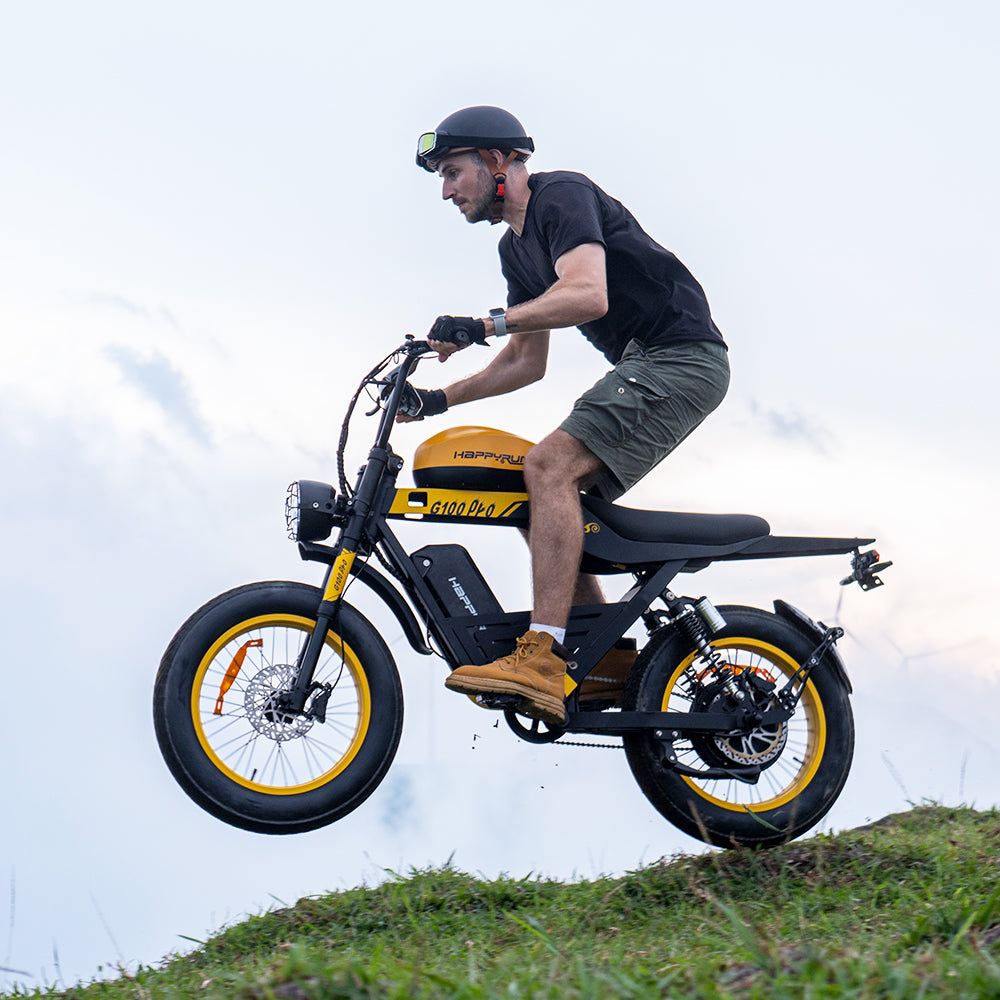
The HappyRun G100 Pro is a high-output, dual-battery electric bike built for riders who care more about power, range and all-terrain capability than traditional bicycle weight or simplicity. HappyRun's current first-party specifications center on a 6,000W peak drive system, a combined 72V 33Ah battery setup, up to 50 mph and up to 78 miles of published range.
Those figures put the G100 Pro well outside the normal commuter e-bike conversation. The useful question is not whether the numbers are impressive. It is whether the battery, chassis, suspension, brakes, size and intended riding environment make sense for the buyer.
This HappyRun G100 Pro review reconciles the current WattWheelz product data with HappyRun's present manufacturer specifications, flags the fit dimensions that differ by source revision, and explains where the G100 Pro sits relative to the G300 Pro.
HappyRun G100 Pro Review: Quick Verdict
The G100 Pro is strongest for an experienced adult rider who wants a long-range, moto-style fat-tire platform with two batteries, high peak power and a large payload rating. At generation time, WattWheelz lists the G100 Pro from $2,199, subject to current variant, promotion and availability. Confirm the live HappyRun G100 Pro price and configuration before ordering.
Its clearest advantages are the 72V electrical system, 33Ah combined capacity, 50 mph published maximum, full suspension and 400 lb payload rating. Its tradeoffs are substantial weight, long standard charging time, difficult transport and performance that requires much more legal and safety planning than a conventional Class 1–3 e-bike.
HappyRun G100 Pro Specs at a Glance
| Specification | Current published figure |
|---|---|
| Peak power | Up to 6,000W |
| Battery system | 72V 18Ah upper + 72V 15Ah lower; 33Ah combined |
| Published top speed | Up to 50 mph |
| Published range | Up to 78 miles |
| Charging | 2A charger; roughly 7–8 hours |
| Throttle | Half-twist |
| Tires | 20 x 4-inch fat tires |
| Suspension | Full suspension |
| Brakes | Hydraulic discs; 180mm front / 203mm rear published by HappyRun |
| Net weight | Approximately 159 lb manufacturer-listed |
| Payload | Up to 400 lb |
These are published figures rather than WattWheelz laboratory measurements. Rider weight, battery state, terrain, temperature, tire pressure and riding style can materially change speed and range.

6,000W Peak Power: How to Read the Number
Peak power is the short-duration ceiling used during harder acceleration and higher load. It should not be read as 6,000 watts of continuous output at every moment. What matters to a buyer is that the G100 Pro operates in a very different performance envelope from a 750W commuter.
High output can be useful for hills, heavier riders and loose terrain, but it also amplifies traction, braking and rider-control demands. The best use case is private-property or legal off-road riding where the rider can actually use the platform's performance.
72V 33Ah Dual Batteries: The G100 Pro's Core Advantage
The dual-battery architecture is arguably more important than the peak-power headline. HappyRun currently specifies one 72V 18Ah battery and one 72V 15Ah battery, creating 33Ah of combined capacity. At a nominal 72 volts, that is a large energy reserve for a high-output bike.
Dual batteries also distribute the stored energy across two packs. That does not make the bike light—HappyRun lists about 159 lb—but it gives the G100 Pro a compelling long-range value proposition for riders who do not want to stop frequently to recharge.
What Does the 78-Mile Range Claim Mean?
HappyRun publishes up to 78 miles. That is an upper-bound figure, not a promise for continuous 50 mph riding. A heavy rider repeatedly accelerating at high power, riding into wind or climbing steep grades can consume the battery much faster.
Range shoppers should compare the G100 Pro by battery capacity and actual route demands rather than by one maximum figure. For long-distance buyers, the dual 72V battery system is the more durable reason to consider the bike.
Charging Time and Daily Ownership
The standard 2A charging setup is conservative and HappyRun currently lists roughly seven to eight hours. For overnight charging this can be acceptable. For a rider expecting multiple deep discharge-and-recharge cycles in one day, it is a constraint.
Battery ownership also means planning storage, temperature and charging practices. Use compatible charging equipment, inspect packs and connectors regularly and follow the current manufacturer instructions.

Suspension, Fat Tires and Terrain
The G100 Pro combines front and rear suspension with 20 x 4-inch fat tires. That layout makes sense for mixed surfaces, broken pavement and looser terrain. Fat tires add compliance and traction but also increase rolling resistance and are one reason the G100 Pro should not be expected to feel like a lightweight bicycle.
At this weight and speed class, setup matters. Tire pressure, suspension preload or damping where adjustable, rider mass and cargo change how controlled the bike feels.
Hydraulic Brakes and Stopping Hardware
HappyRun currently lists hydraulic disc brakes with a 180mm front and 203mm rear rotor configuration. Hydraulic actuation is appropriate for a heavy high-output bike, but published hardware does not remove the need for inspection and maintenance.
Brake pad bedding, rotor condition and lever feel should be checked before aggressive riding. A machine capable of a 50 mph published maximum needs substantially more stopping distance than a normal city e-bike.
Weight, Payload and Transport Reality
The manufacturer lists the G100 Pro at about 159 lb with a payload rating up to 400 lb. The payload number helps heavier riders and cargo use cases, but the bike's own weight creates a transport problem many shoppers overlook.
Before ordering, verify that your vehicle rack is actually rated for the bike's real weight and wheelbase. Stairs, apartments and tight storage can be more limiting than motor power.
Current Fit-Spec Differences: Seat Height and Rider Range
The current WattWheelz page and HappyRun's present manufacturer page do not show identical fit figures. WattWheelz's current geometry copy lists about a 33-inch seat height and a 5'4"–6'3" rider range, while HappyRun currently lists a 32-inch seat height and 5'3"–6'5" rider range.
This is best treated as revision or measurement-method drift rather than silently choosing one number. Riders near either end of the fit range should confirm the current fulfilled geometry before purchasing.
G100 Pro vs HappyRun G300 Pro
| Priority | G100 Pro | G300 Pro |
|---|---|---|
| Battery strategy | Dual-battery 72V 33Ah focus | Different high-output architecture; verify current SKU specs |
| Use case | Long-range moto-style fat-tire riding | Performance-focused off-road alternative |
| Weight/transport | Very heavy | Still a substantial high-output platform |
| Best reason to choose | Range + payload + dual batteries | Different performance/chassis preference |
Read the full HappyRun G300 Pro review before treating either model as automatically better. For a wider lineup comparison, see the Best HappyRun Electric Bikes of 2026.

HappyRun G100 Pro Pros
- Large 72V 33Ah combined battery capacity.
- Up to 6,000W published peak output.
- Up to 50 mph and 78 miles published.
- 400 lb payload rating.
- Full suspension and 20 x 4-inch fat tires.
- Hydraulic disc brakes.
- Dual-battery design is useful for long-range riders.
HappyRun G100 Pro Cons and Tradeoffs
- Approximately 159 lb is extremely heavy for an e-bike.
- Standard 2A charging is slow for the battery capacity.
- High-output operation may not fit ordinary e-bike rules.
- Pedaling and manual transport are secondary use cases.
- Fit specifications differ slightly between current dealer and manufacturer sources.
Who Should Buy the G100 Pro?
Choose the G100 Pro if you are an experienced adult rider prioritizing battery capacity, range, payload and high-output recreational capability, and you have a legal place to use it. It is especially logical for buyers who value the dual-battery system more than low weight.
Browse the full HappyRun collection if you want to compare current alternatives.
Who Should Skip It?
Skip it if you need a lightweight commuter, easy stair carrying, a normal bicycle feel or straightforward use on infrastructure limited to conventional e-bike classes. It is also a poor fit if your transport setup cannot safely carry a roughly 159-lb bike.
Final Verdict
The G100 Pro's best argument is not simply “6,000 watts.” It is the combination of a 72V platform, 33Ah of combined battery capacity, long published range, full suspension and a 400-lb payload rating. That package gives it a clear role for high-output, long-range buyers.
The same features make it specialized. Weight, charge time, transport and local legality deserve as much attention as speed. If those tradeoffs fit your use case, check the current G100 Pro offer. If you are unsure, use Find My E-Bike.
G100 Pro Ownership Checklist Before Delivery
Before ordering a G100 Pro, plan the ownership details that do not show up in a motor-power headline. Confirm where the bike will be stored, how it will be moved when the batteries are low or removed, and whether the rack or trailer you intend to use is rated for the complete bike weight. A roughly 159-pound platform can exceed the per-bike rating of many standard bicycle racks even when the vehicle hitch itself is rated for more.
Also plan around charging. The dual-battery system is one of the G100 Pro's strongest advantages, but the standard published seven-to-eight-hour recharge window makes overnight charging the natural routine for many owners. Keep both packs, their connectors and the supplied charging equipment dry, clean and visually inspected. If one battery begins behaving differently from the other, treat that as a service issue rather than trying to mask it through riding habits.
Finally, inspect brakes, tire pressure, fasteners and suspension setup before higher-speed riding. On a high-output platform, basic pre-ride maintenance has a direct effect on stopping distance, traction and chassis control. The G100 Pro rewards buyers who are comfortable treating it more like powersports equipment than a casual bicycle.
Frequently Asked Questions
How fast is the HappyRun G100 Pro?
HappyRun currently publishes up to 50 mph. Real speed varies with rider weight, battery state, terrain and configuration.
How much power does the G100 Pro have?
Current first-party material lists up to 6,000W peak output. Peak is not the same as continuous output.
What batteries does the G100 Pro use?
HappyRun currently lists a 72V 18Ah upper battery and 72V 15Ah lower battery, or 33Ah combined.
How far can it go?
The published maximum is up to 78 miles. Aggressive riding can reduce that substantially.
How much does it weigh?
HappyRun currently lists approximately 159 lb.
What is the payload rating?
The current manufacturer-listed payload is up to 400 lb.
Is it a normal Class 3 e-bike?
Do not assume that. Its published performance is far beyond ordinary class-speed limits. Check local rules for the exact configuration and intended riding area.
Is the G100 Pro better than the G300 Pro?
Not universally. The G100 Pro makes the clearest case around dual-battery range and payload; the G300 Pro serves a different performance-focused buyer. Compare both current specifications.
Sources & Verification
- WattWheelz — current HappyRun G100 Pro product page
- HappyRun — current G100 Pro manufacturer specification page, checked during September 2026 research
- WattWheelz — Best HappyRun Electric Bikes of 2026
Core power, battery, speed, range, tire and payload claims reconcile across the current WattWheelz and HappyRun source set. Rider-height and seat-height figures differ slightly and are disclosed in the review rather than silently normalized.


