
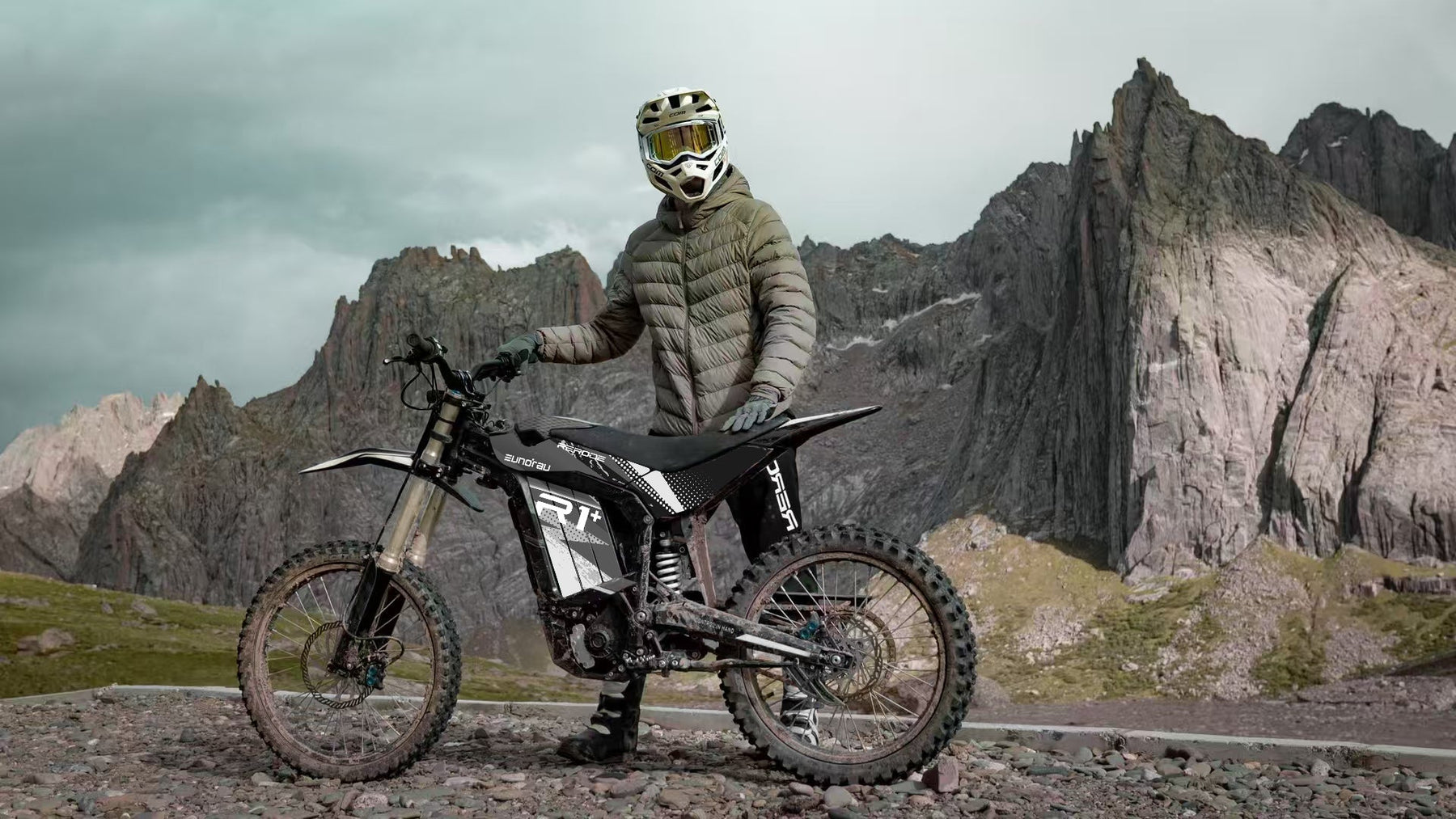
The EUNORAU Rerode R1+ sits at the extreme-performance end of the WattWheelz catalog. It is not a conventional pedal-assist commuter with a little extra torque. It is a 72V off-road electric dirt bike built around a 5,000W nominal mid-drive system that EUNORAU and Rerode publish at up to 17,000W peak power, paired with a removable 72V 40Ah Samsung-cell battery, full suspension and motorcycle-style braking hardware.
That makes the R1+ compelling for a specific buyer: someone who wants a high-output electric dirt platform for private property, tracks or legal off-highway riding areas and who understands the weight, speed, charging and legal implications of owning something this powerful. It also means the biggest number on the spec sheet should not be the only reason you buy it.
This review breaks down the current R1+ configuration sold by WattWheelz, including live store pricing at draft time, published motor output, battery capacity, range claim, suspension, brakes, fit, charging, ownership tradeoffs and how it compares with the lower-priced Rerode R1.
EUNORAU Rerode R1+ Review: Quick Verdict
Best for: experienced riders who want maximum electric dirt-bike output, strong climbing performance, long suspension travel and a large 72V battery in one platform.
Current WattWheelz price: $4,799.00. Pricing can vary by color, configuration or promotion, so confirm the final price on the Rerode R1+ product page before ordering.
Why it stands out: the combination of 17kW published peak output, 500 N·m published peak wheel torque, a 72V 40Ah battery, 200mm front suspension travel and four-piston hydraulic brakes places it far beyond normal e-bike territory.
Main tradeoffs: 150 lb published weight, no pedals, substantial performance that may not be legal on public roads or bicycle paths, and a price that only makes sense if you will actually use the capability.
R1+ Specifications at a Glance
| Specification | Published R1+ figure |
|---|---|
| Drive system | 72V 5,000W LPMSM mid-drive |
| Peak power | 17,000W |
| Peak wheel torque | 500 N·m |
| Battery | 72V 40Ah Samsung-cell removable lithium-ion |
| Battery energy | 2,880Wh calculated from 72V × 40Ah |
| Published maximum speed | 59 mph / 95 km/h |
| Published range | Up to 75 miles / 120 km under roughly 16 mph / 25 km/h test conditions |
| Charger | 72V 10A |
| Published charge time | About 4 hours |
| Front suspension | 200mm travel with high- and low-speed compression damping |
| Rear suspension | 85mm travel |
| Brakes | Four-piston hydraulic |
| Brake rotors | 220mm front / 203mm rear |
| Weight | 150 lb / 68 kg |
| Recommended rider height | 5'2"–6'4" |
These are manufacturer-published figures, not independent WattWheelz dynamometer or range-test results. In particular, peak power should not be confused with continuous output, and the headline range is measured under much gentler speed conditions than the bike's maximum-speed capability.
17,000W Peak Power: What the Number Actually Means

The R1+ is marketed around a 17,000W peak figure, but the more useful way to understand the drivetrain is to separate nominal and peak output. EUNORAU's current WattWheelz listing describes the system as a 72V 5,000W advanced LPMSM mid-drive with peak power up to 17,000W.
That distinction matters because peak power describes the short-duration ceiling available during hard acceleration or demanding load conditions. It is not the same as saying the motor continuously produces 17kW. For comparison shopping, treating the R1+ as a 5kW nominal platform with a very high peak-output envelope is more informative than focusing on the largest headline number alone.
Rerode also publishes 500 N·m of peak wheel torque. On steep climbs and low-speed technical terrain, torque delivery and throttle control can matter as much as top speed. The R1+ uses Eco, Sports and Sports+ riding modes, giving the rider some ability to temper how aggressively the available performance is delivered.
72V 40Ah Battery: Capacity, Range and What to Expect

The removable 72V 40Ah pack is one of the strongest reasons to consider the R1+. Multiplying nominal voltage by amp-hours gives approximately 2,880Wh of energy capacity. That is a very large pack compared with a typical commuter e-bike battery.
EUNORAU publishes up to 75 miles / 120 km of range, but the important qualification is the test condition: the figure is tied to riding at roughly 16 mph / 25 km/h. A machine capable of much higher speeds will consume energy dramatically faster when ridden aggressively. Rider weight, elevation change, tire pressure, temperature, surface, acceleration and mode selection also change real-world range.
For buyers, the right takeaway is not that every R1+ will travel 75 miles in every scenario. It is that the battery is large enough to support longer off-road sessions when ridden efficiently, while high-speed or repeated hard-acceleration riding can reduce that distance substantially.
Charging: Why the 10A Charger Matters
The R1+ includes a 72V 10A charger and EUNORAU publishes a roughly four-hour full-charge time. For a 2,880Wh pack, that is notably faster than many lower-amperage e-bike charging systems.
The removable battery gives owners flexibility to charge away from the bike, but a large high-voltage battery should still be treated as serious electrical equipment. Use the supplied or manufacturer-approved charger, inspect connectors and the pack for damage, and follow the manufacturer's charging and storage instructions.
If your riding pattern regularly uses only part of the battery, there is no requirement to fully drain the pack before every recharge. Lithium-ion batteries do not need the deep-discharge routine associated with some older battery chemistries.
Suspension and Chassis: Built for Actual Dirt-Bike Use

The front end uses 200mm of published travel with high- and low-speed compression damping, while the rear shock is listed at 85mm of travel. That is a major clue about what the R1+ is designed to do: absorb real off-road impacts, braking loads and terrain changes rather than simply smooth cracks in city pavement.
The aluminum-alloy frame, 19-inch front and 18-inch rear wheel setup, and CST off-road tires further separate it from bicycle-style fat-tire machines. The staggered wheel arrangement is common in dirt-bike design because the larger front wheel helps roll over obstacles while the smaller rear supports traction and packaging.
At a published 150 lb, however, this is not a light trail bicycle. Loading it into a truck, moving it up stairs or recovering it from a tip-over requires more effort. Prospective owners should think about transport and storage before buying.
Braking: Four Pistons and Large Rotors Are Necessary Here
The R1+ uses four-piston hydraulic brakes with a 220mm front rotor and 203mm rear rotor. On a 150 lb machine with a published top speed approaching 60 mph, this level of braking hardware is not an optional luxury. It is part of the minimum performance package needed to manage the vehicle's mass and speed.
Brake condition matters especially on high-output electric dirt bikes. Pad wear, rotor condition, hydraulic feel and tire traction should be checked regularly, particularly after wet, muddy or aggressive riding. A powerful drivetrain does not compensate for weak braking maintenance.
59 MPH Published Top Speed: Who Actually Needs It?
EUNORAU lists a maximum speed of 59 mph / 95 km/h. That number makes the R1+ exciting on paper, but it should not be treated as a target for every ride or every rider.
Speed dramatically raises the consequences of poor terrain choice, limited visibility, weak protective equipment or an unexpected obstacle. Riders considering the R1+ should already be comfortable with powerful two-wheel vehicles and should use protective equipment appropriate for off-road motorcycle-level performance.
The more useful question is whether the R1+ gives you enough reserve for steep climbs, acceleration and demanding terrain, not whether you plan to hold maximum speed. Many buyers will get more value from the torque and suspension than from the absolute speed ceiling.
Rider Fit and Ergonomics
WattWheelz currently lists a recommended rider-height range of approximately 5'2" to 6'4". Height guides are useful, but they do not replace actual fit considerations such as inseam, reach, riding experience and comfort with a heavy machine.
The R1+ has no pedals and uses a motorcycle-style twist throttle. That changes both how the rider interacts with the vehicle and how the product is treated legally. If you are shopping for something you can pedal home with a depleted battery or use as a conventional bicycle, this is not the right platform.
R1+ vs R1: Is the Flagship Worth the Extra Money?

The lower-priced Rerode R1 is the most obvious alternative within the same family. Both are 72V electric dirt-bike platforms, but the R1+ is the higher-output flagship.
The R1+ adds a larger 40Ah battery, higher published peak power, 500 N·m peak wheel torque, larger wheel/tire package and upgraded front suspension and braking hardware. The R1 gives buyers a way into the same basic off-road mission for less money and may be the smarter purchase if you cannot identify a real use for the R1+'s extra ceiling.
If budget is secondary and you specifically want the strongest Rerode platform WattWheelz carries, the R1+ is the clear choice. If value per dollar matters more than maximum output, compare both before ordering.
Is the R1+ an E-Bike for Public-Road Use?
This is one of the most important ownership questions. The R1+ has no pedals and far exceeds the federal low-speed electric-bicycle power and speed thresholds. Under the federal consumer-product definition, a low-speed electric bicycle requires fully operable pedals, an electric motor under 750W and a motor-only maximum speed below 20 mph under specified conditions.
That does not automatically tell you every state or local rule that applies to an R1+, but it does mean buyers should not assume ordinary e-bike access rules apply. Treat the R1+ as an off-road electric dirt bike unless you have verified the laws for the exact place you intend to ride. Public streets, bike lanes, multi-use paths, trails and OHV areas can all have different rules.
Who Should Buy the EUNORAU Rerode R1+?
The R1+ makes the most sense for riders who already know they want a high-performance electric dirt bike rather than a conventional e-bike. Strong candidates include experienced off-road riders, private-land owners, riders with legal OHV access and buyers who value high torque, long-travel suspension and a large battery more than portability or pedal functionality.
It is also a fit for buyers who were already considering other high-output electric dirt-bike platforms and want to compare the R1+ on battery size, peak power, suspension and purchase price. Browse the broader electric dirt bike collection if you are still comparing architectures.
Who Should Skip the R1+?
Skip it if your main use is urban commuting, bike-path riding, easy apartment storage or casual neighborhood recreation. A lighter Class 1, 2 or 3 e-bike will usually be easier to transport, easier to insure where applicable, simpler to ride legally in bicycle infrastructure and less intimidating for newer riders.
You should also skip it if you are buying mainly because 17,000W sounds impressive. The R1+ only delivers good value when its capability matches your terrain, experience and riding access. For broader guidance across EUNORAU's lineup, read Best EUNORAU Electric Bikes of 2026.
Buying the R1+ From WattWheelz: What to Confirm
Before placing an order, confirm the current color availability, final variant price, delivery expectations and any current promotional terms on the WattWheelz R1+ product page. The broader EUNORAU collection is useful if you want to compare the R1+ against lower-output fat-tire, mountain or utility models from the same manufacturer.
If you are not sure whether a high-output dirt platform or a more conventional e-bike better fits your use case, the Find My E-Bike tool can help narrow the decision by budget, terrain and riding style.
Final Verdict: Is the Rerode R1+ Worth It?
For the right rider, yes. The R1+ combines a large 72V 40Ah battery, very high peak-output capability, strong published torque, long-travel front suspension and serious braking hardware in a package designed for aggressive off-road use.
But it should be purchased for what it actually is, not because it sits in an e-bike store. It is heavy, has no pedals, carries off-road-motorcycle-level performance and requires more thought around transport, protective equipment and legal riding areas than a normal pedal-assist bike.
If those tradeoffs are acceptable and you specifically want the strongest Rerode platform in the WattWheelz EUNORAU lineup, the R1+ deserves a place near the top of your shortlist.
Frequently Asked Questions
How much power does the EUNORAU Rerode R1+ have?
EUNORAU publishes a 5,000W nominal LPMSM mid-drive system with up to 17,000W peak power. Peak power should not be confused with continuous motor output.
What battery does the R1+ use?
The current R1+ specification uses a removable 72V 40Ah Samsung-cell lithium-ion battery, equal to about 2,880Wh based on nominal voltage multiplied by capacity.
How fast is the Rerode R1+?
EUNORAU publishes a maximum speed of 59 mph / 95 km/h. Actual speed can vary with rider, conditions and configuration, and riders should only operate it where that use is legal and appropriate.
What is the claimed range?
The published figure is up to 75 miles / 120 km under approximately 16 mph / 25 km/h conditions. Faster and more aggressive riding can materially reduce real-world range.
How long does the R1+ take to charge?
The manufacturer lists a 72V 10A charger and approximately four hours for a full charge under its stated conditions.
Does the R1+ have pedals?
No. The R1+ is a twist-throttle electric dirt bike rather than a conventional pedal-assist bicycle.
Is the R1+ street legal?
Do not assume normal e-bike road or bike-path rules apply. It has no pedals and exceeds federal low-speed e-bike thresholds. Check state and local vehicle and off-highway rules for the exact place you plan to ride.
Should I buy the R1+ or the R1?
Choose the R1+ if you want the flagship battery, peak output, torque, suspension and braking package. Choose the R1 if you want a lower purchase price and do not need the R1+'s maximum performance ceiling.


