Shopping for an adult electric dirt bike and stuck between HappyRun G300 Pro, Freego X2 Pro and 79Bike Falcon Pro? Each promises high output, but the more useful question is which design matches your terrain, your budget, your ability to transport a heavy machine and the places you are legally allowed to ride. Below is a source-grounded comparison of published manufacturer claims—not an invented hands-on test.
Quick verdict: which electric dirt bike should you buy?
Choose the HappyRun G300 Pro if your goal is substantial 72V off-road performance at a comparatively accessible price and you can handle a heavy bike. Choose the Freego X2 Pro if you specifically want pedal-assist equipment and the manufacturer's urban/off-road modes; that feature does not, by itself, establish where a particular configuration is legal. Choose the 79Bike Falcon Pro if your priorities are a more powerful premium e-moto platform, upgraded suspension and a larger battery, and your budget accommodates the higher cost.
These are three very different choices. The G300 Pro is the value-and-output option, the X2 Pro combines a distinct pedal-equipped layout with 60V power, and the Falcon Pro targets enthusiasts who want more premium e-moto capability. None automatically wins merely by posting a larger number on a specification sheet.

Published specs compared: power, battery and size
Use the following figures as published model references, not independently verified dyno readings. The G300 Pro carries a 72V 30Ah pack, or approximately 2,160 nominal watt-hours. Freego lists a 60V 30Ah base battery for the X2 Pro, equivalent to 1,800Wh, plus a separately selected 60V 40Ah (2,400Wh) option on the current US manufacturer page. Check which battery variant is selected before comparing price or range. The Falcon Pro's 72V 35Ah pack equals approximately 2,520Wh. Energy capacity is a better first comparison for potential ride duration than amp-hours alone.
The advertised peak outputs are 6,500W for the G300 Pro, 6,000W for the X2 Pro and 10,000W for the Falcon Pro. Peak output is not the same as sustainable continuous power, and neither peak wattage nor battery voltage guarantees more grip, shorter stopping distance or a longer full-power ride.
| Specification | HappyRun G300 Pro | Freego X2 Pro | 79Bike Falcon Pro |
|---|---|---|---|
| Battery | 72V 30Ah / ~2,160Wh | 60V 30Ah / ~1,800Wh; optional 40Ah / ~2,400Wh | 72V 35Ah / ~2,520Wh |
| Published peak power | 6,500W | 6,000W | 10,000W |
| Claimed off-road top speed | Up to 50 mph | Up to 50 mph | Up to 56 mph |
| Published range claim | Up to 70 miles | 30Ah: 37–56 mi on US page; separate technical sheet: up to 56 city / ~20 off-road | Up to 75 miles |
| Positioning | Value performance | Dual-mode pedal equipped | Premium e-moto |
Why 72V does not automatically beat 60V
A higher nominal battery voltage can help a manufacturer deliver high power at lower current for the same wattage, depending on the controller, motor and wiring. That is an engineering advantage, not a promise of better acceleration or endurance in every situation. Rider weight, controller calibration, gearing, battery current limits and tire traction all matter.
The Freego X2 Pro is an example: it can post a manufacturer-claimed off-road top speed in the same vicinity as the HappyRun despite its lower voltage, but it carries less nominal battery energy. For the bigger battery explanation, compare the already-published 60V versus 72V electric dirt bike guide.
HappyRun G300 Pro: strongest for value-focused 72V buyers
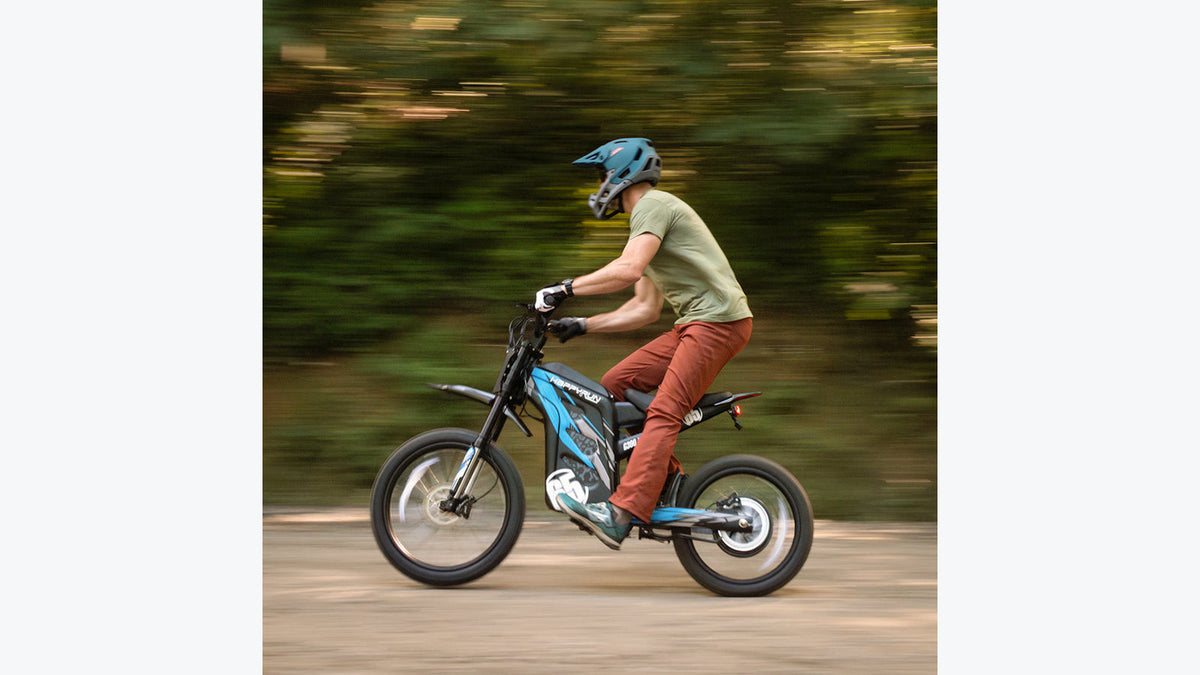
The G300 Pro's practical appeal is access to a 72V 30Ah battery, full suspension, hydraulic brakes and a manufacturer-claimed 6,500W peak without moving into the premium price bracket. Its claimed maximum speed is up to 50 mph in the appropriate off-road mode. For a buyer with legal private-property access and a place to store a substantial bike, that is a compelling configuration.
The downside is physical mass. HappyRun lists the bike around 136.8 pounds, with a roughly 31-inch seat height. Loading it into a truck, recovering it after a fall and navigating tight areas will feel unlike moving a 50-pound pedal-first e-bike. Read our full G300 Pro review for the expanded fit and ownership breakdown.

Freego X2 Pro: who the pedal-equipped 60V format suits
The base X2 Pro provides a 60V 30Ah pack (with a 40Ah variant also listed by Freego), a rear hub motor advertised at up to 6,000W peak, 203mm hydraulic brake rotors and a pedal-assist sensor. Freego distinguishes an urban mode, with lower speed and output, from a high-output off-road mode. Its older technical summary lists up to 56 miles in city use and around 20 miles off road; the current US product page lists a 37–56-mile 30Ah range without a comparable off-road figure. These claims use different conditions and should not be presented as one independent test. Plan by ride mode and battery variant, not a marketing maximum.
The presence of pedals and an urban setting should never be interpreted as blanket road or bicycle-trail permission. Local e-bike definitions and rules may depend on motor rating, assisted speed, throttle behavior, manufacturer labeling and actual configuration. Buy the X2 Pro for its intended layout and specific riding requirements, not because a retailer promises unrestricted street access.

79Bike Falcon Pro: when the premium upgrade is justified
The Falcon Pro moves the comparison to a premium e-moto platform. The published system has a 72V 35Ah battery, a claimed peak output of 10,000W, roughly 130-pound bike weight and FastAce suspension. For an experienced rider using approved off-road locations, the appeal is the combination of higher output, 2.52kWh nominal battery energy and off-road-oriented hardware.
The tradeoff is a materially higher purchase price, shipping-term verification and more demanding safety, parts and handling considerations. WattWheelz currently lists free freight shipping included in the Falcon Pro item price. Verify this against the selected configuration and shipping destination at checkout rather than assuming the total landed price. See the Falcon Pro product page for variants, delivery and manufacturer details.

Real-world range: the headline maximum is not an off-road promise
The range problem is especially important for a buyer comparing these bikes. Battery energy can indicate potential endurance, but heavy acceleration, hills, deep sand, tire pressure, temperature and sustained speed change energy consumption dramatically. Freego's different product-page and technical-sheet range claims show why a single headline is not enough. The 40Ah option also changes battery energy and potential range.
Plan the intended route with a reserve, identify where charging is available and establish how much full-power riding you actually expect. A larger battery does not necessarily mean longer riding if the motor is driven much harder. The electric dirt bike buyer guide explains how to calculate watt-hours and compare realistic use cases.
Brakes, suspension and traction matter more as speed rises
Once an off-road machine can approach motorcycle speeds, braking performance and suspension behavior become major purchase criteria. On loose ground, tires and surface conditions can become the limiting factors even with four-piston brakes. Compare published rotor sizes, adjustability, replacement pads, suspension travel and tire sizes before treating any two bikes as equivalent.
Freego publishes four-piston hydraulic disc brakes and 203mm rotors for the X2 Pro. HappyRun specifies hydraulic brakes with 180mm front and 203mm rear rotors. The Falcon Pro lists FastAce suspension and hydraulic disc braking. Those details matter, but maintenance condition, setup and rider technique remain essential.
Handling and transport: where the spec sheet stops
An e-moto may be excellent on open private land and frustrating in a cramped condo. Consider whether you can wheel it through a narrow door, lift it into a truck and secure it for travel. The HappyRun is listed at 136.8 pounds; the Falcon Pro at roughly 130 pounds. Transporting either may require a motorcycle-rated carrier rather than a standard bicycle rack.
Think about seat height as well as body weight. A rider must be able to stop, balance, manage the throttle and recover the machine after a tip-over. For new riders, smooth delivery and fit often matter more than a higher maximum speed.
Where can you legally ride these electric dirt bikes?
Do not assume a high-output electric dirt bike qualifies as a Class 1, Class 2 or Class 3 bicycle just because a model has pedals or an on-road setting. Definitions vary across jurisdictions, and the maximum assisted speed and motor capability may exceed applicable e-bike limits. Public trail managers can impose stricter access rules than nearby roads.
Before ordering, check the laws and land manager's rules for the exact riding location and vehicle configuration. These platforms are best evaluated first as off-road-focused products. A dealer or manufacturer performance description is not legal authorization to use a public road.
What will ownership and servicing cost?
At these power levels, ownership is not limited to keeping a battery charged. Expect ongoing wear of tires, brake pads and drivetrain parts. Check which parts are supplied through the manufacturer and whether replacement batteries, controllers and suspension service options are reasonably accessible. A lower purchase price loses its advantage if a critical component is hard to replace.
Compare warranty terms carefully. Battery, motor, frame and wear items may have different coverages and exclusions. High-speed modifications, water exposure, crashes and unauthorized charging hardware can affect coverage. WattWheelz can help check current manufacturer terms before you buy.
Which one makes the most sense by budget and rider?
For a value-focused adult who has suitable off-road riding access and prioritizes 72V performance, start with HappyRun G300 Pro. For the buyer who specifically needs the Freego format, pedals, 60V setup and mode flexibility, evaluate Freego X2 Pro while confirming legal use. For experienced riders prioritizing a premium performance chassis and larger pack, consider Falcon Pro after verifying current included-freight terms.
Compare more models in the 79Bike collection. Use the Electric Dirt Bikes for Adults collection to compare other available models and budget tiers. A model leaving or entering stock should not make this entire buyer guide obsolete: compare product architecture first and the current offer second.
Before checkout: a six-point selection checklist
Write down the exact riding terrain, whether you can legally use the machine there, your height and comfort at the seat, your storage/transport method, expected ride duration and complete landed cost. Confirm color and configuration before comparing price because variants may have different equipment or shipping methods.
Finally, verify current stock, dealer warranty coverage and freight charges. If you have questions about which platform fits your needs, contact WattWheelz through the adult electric dirt bike collection rather than deciding purely from maximum watts.
Frequently Asked Questions
Is the HappyRun G300 Pro faster than the Freego X2 Pro?
Both manufacturers publish up to roughly 50 mph in an off-road mode. Those are claimed maximums under manufacturer conditions, not a guarantee of identical acceleration, handling or sustained speed.
Why does the Falcon Pro cost more?
Its higher advertised peak power, larger 72V 35Ah battery and premium off-road component package place it in a different price and use-case tier. Decide whether those differences solve a real need.
Which bike has the biggest battery?
The Falcon Pro's 72V 35Ah pack is about 2,520 nominal watt-hours, compared with 2,160Wh for the G300 Pro and 1,800Wh for the standard 30Ah X2 Pro. Freego also sells a 40Ah X2 Pro configuration with approximately 2,400Wh.
Is the Freego X2 Pro street legal?
Do not assume so from an urban mode or pedals. Verify the exact configuration and applicable state and local requirements before riding on public roads or paths.
Can I ride a high-power dirt e-bike on bicycle trails?
Not automatically. Many bicycle paths and public trails restrict high-power motorized vehicles even when bicycles are allowed. Consult the trail manager.
Which one is best for a beginner?
Prioritize controllability, appropriate protective equipment, fit and low-power settings. These are high-output machines and may not be suitable beginner vehicles.
How realistic are 70- or 75-mile range claims?
They are best-case manufacturer figures. Aggressive off-road riding can use substantially more battery per mile; build in reserve and plan your route.
Do these bikes need motorcycle-rated racks?
Given their weight, check the rack and vehicle specifications. Standard lightweight bicycle racks may not be suitable; consult the carrier manufacturer.
Does 72V always mean more torque?
No. Controller current, motor characteristics, gearing and traction determine how electrical power translates into force at the wheel.
Should I compare purchase price or delivered cost?
Compare total checkout cost including freight, accessories and any applicable tax. WattWheelz currently lists free freight shipping included for the Falcon Pro; verify live checkout terms for your chosen configuration.
Sources & Verification
Specifications and manufacturer range figures are published claims, not independent WattWheelz performance tests. Check the exact model, selected configuration, current price and stock on the product page before ordering.