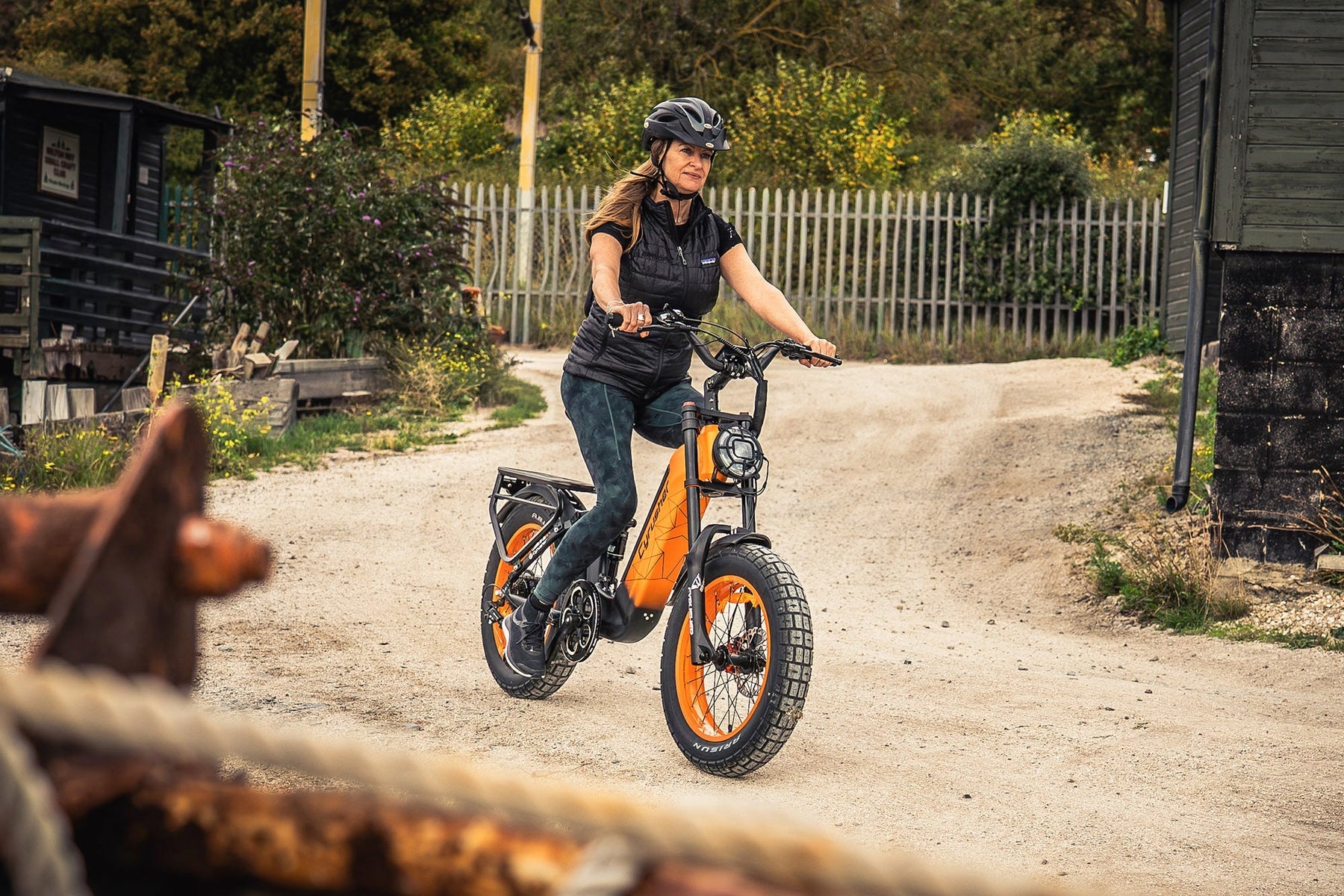

There is a misconception that "Step-Through" frames (frames without the high top bar) are only for casual city riding. Modern engineering has changed that. Bikes like the Cyrusher Kommoda utilize reinforced, hydroformed aluminum frames that maintain structural rigidity even while enduring off-road punishment. This design opens up the world of off-roading to riders with limited hip flexibility or those who simply want the convenience of easy mounting and dismounting.
When you combine a step-through frame with motorcycle-grade components like Bafang motors and full suspension, you get a "Crossover" vehicle. It’s capable of shredding fire roads and gravel trails on the weekend, but it’s also dignified and easy to use for a coffee run on Monday morning. It offers the best of both worlds: the accessibility of a cruiser with the heart of a mountain bike.
Why Step-Through E-Bikes Work for More Than Commuting
A step-through frame changes how you get on and off the bike, not simply where the bike can be ridden. That matters for riders who make frequent stops, carry cargo, ride in everyday clothes, have limited hip mobility, or simply prefer not to swing a leg over a high top tube. The frame style can work for errands, recreational rides, travel, family use, RV trips and mixed urban riding just as naturally as it works for commuting.
The biggest mistake is treating “step-through” as a performance category. It is a frame-access choice. Motor power, battery capacity, tires, suspension, brakes, gearing and payload still determine what the e-bike is actually suited for. A step-through cargo bike and a lightweight step-through folder may share an easy-entry frame while serving completely different riders.
Who Should Put a Step-Through Frame High on the List?
Riders who stop frequently often appreciate the easier mount and dismount. That includes city riders, parents loading children or cargo, delivery-style users, RV travelers and people who regularly start and stop on crowded paths. It can also be useful for shorter riders and anyone who finds a tall top tube awkward.
For a lightweight folding example, see the Urtopia Carbon Fold 1. For cargo-focused use, compare the HOVSCO HovCart. Riders looking for a full-size fat-tire step-through can also compare the HOVSCO HovAlpha Step-Thru. These three bikes illustrate why frame style alone should never determine the purchase.
Step-Through vs Step-Over: What Actually Changes?
A traditional step-over frame uses a higher top tube, while a step-through lowers or removes that barrier. The practical benefit is easier access. The tradeoff is that frame engineering becomes more important because the structure has to manage loads without the same traditional triangle. Modern e-bike design can compensate with larger tubing, carbon construction or reinforced geometry, so buyers should judge the finished bike rather than assuming one frame shape is always stronger than another.
For most everyday buyers, the better question is whether the frame makes the bike easier and more comfortable to use without compromising the features they need. If you never struggle to mount a conventional frame and prioritize aggressive riding, the step-through advantage may be small. If easy access makes you more likely to ride the bike regularly, it can be one of the most meaningful features on the bike.
Where Step-Through E-Bikes Make the Most Sense
- Urban errands: frequent stops make easy entry useful.
- Family and cargo use: riders can mount more easily when the rear of the bike is loaded.
- RV and travel use: compact or folding step-through models can reduce storage friction.
- Senior and easy-riding use: lower entry can reduce awkward mounting.
- Casual recreation: comfort and approachability may matter more than aggressive frame geometry.
WattWheelz groups relevant options in the Best E-Bikes for Seniors & Easy Riding collection and the broader Electric Bikes collection.
What to Compare Besides the Frame
Start with rider fit and total bike weight. Then compare battery range, motor behavior, tire size, suspension, brakes, payload and storage needs. If you plan to lift the bike into a vehicle or carry it upstairs, a step-through frame does not automatically make a heavy e-bike easy to move. If you carry a passenger or cargo, payload and rack design matter more than frame access alone.
For more model-specific context, read the Urtopia Carbon Fold review and the HOVSCO HovCart review. If you are still deciding whether an e-bike fits your lifestyle at all, use our Pros and Cons of Electric Bikes guide.
Bottom Line
Step-through e-bikes are not “commuter bikes for one type of rider.” They are a frame-access solution that can appear on folding bikes, cargo bikes, fat-tire bikes and everyday city models. Choose the frame because it makes the bike easier to use, then choose the actual e-bike based on terrain, range, payload, storage and riding style.
Common Step-Through Misconceptions
A step-through frame does not automatically mean low power, short range or “beginner bike.” Frame access and drivetrain performance are separate decisions. Some step-through bikes are lightweight commuters; others are fat-tire cargo bikes with high payload ratings. The frame tells you how you enter the bike, not how capable the complete platform is.
It is also not only a senior-focused design. Riders of any age may prefer easier mounting when wearing work clothes, carrying a bag, using a rear rack or making frequent stops. The right question is whether the frame makes your normal riding routine easier without giving up features you actually need.
Storage, Accessories and Daily Ownership
Before buying, check whether your preferred racks, child seats, baskets or panniers are compatible with the exact model. Step-through bikes often attract practical riders, so accessory compatibility can matter as much as motor output. If the bike will be stored indoors, measure doorways, elevators and storage areas as well.
For the EUNORAU side of the category, our FLASH LITE ST guide shows another interpretation of an easy-entry everyday e-bike.
How to Test Whether Step-Through Access Will Matter to You
Think about the moments when mounting and dismounting are hardest, not just the riding itself. Do you stop frequently in traffic? Do you wear a backpack or work clothes? Will there be a child seat, rear bag or cargo load behind you? Do you need to put a foot down often on crowded paths? Those situations can make a lower frame opening more valuable than it first appears.
If possible, compare the motion of getting on a step-through bike with the motion required for a conventional frame. A buyer who feels no difference may be better served by choosing purely on ride characteristics. A buyer who immediately notices easier access should treat frame design as a meaningful ownership feature.
Step-Through Buying Mistakes to Avoid
Do not buy only because the bike looks easier to mount. Confirm fit, battery needs, service access, tire size and whether the model can support your cargo or passenger plans. Also avoid assuming that every step-through model is light. Some are built for utility and can be substantially heavier than a commuter-focused model.
The best step-through e-bike is therefore the one that combines easier access with the correct performance package for the rider. Frame style should remove friction from ownership, not distract from the rest of the decision.
For most buyers, the best frame is simply the one that makes regular riding easier without compromising the features they need.