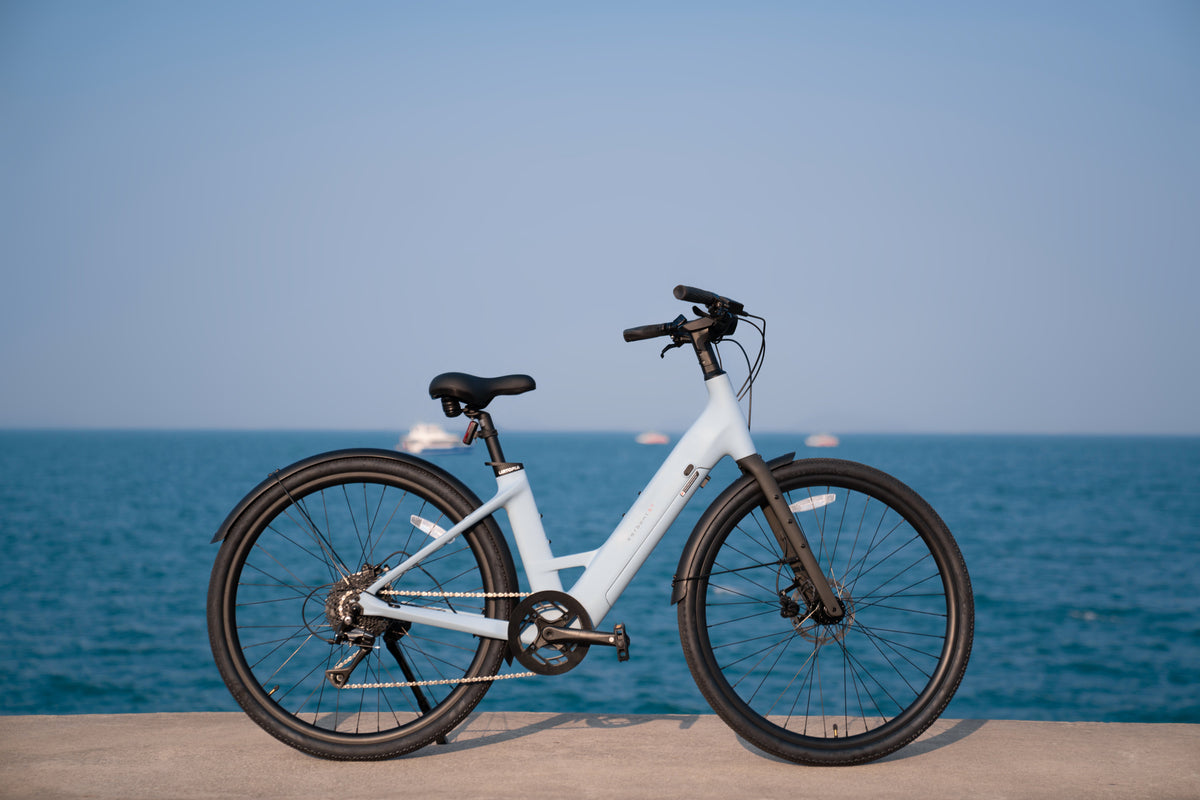
The best lightweight e-bike is the one you can move comfortably when the motor is off. For the lowest manufacturer-listed bike weight in this Watt Wheelz shortlist, start with the Urtopia Carbon Fold 1 at 34.2 lb. Choose the Carbon Fold Step-Thru for a lower frame opening and compact storage, or consider the Carbon 1 Pro for a nonfolding bike with a larger battery. The Carbon 1 Step-Thru combines that larger battery with a low-entry frame, but its published rider-height guidance needs confirmation.
This is a researched buying guide to four options in the Watt Wheelz lightweight e-bike collection, not an all-market ranking or a hands-on test. Specifications and catalog availability were checked on November 9, 2026. The comparison separates complete-bike figures from stripped net weights, then helps you judge the actual lift between your ride and your storage space.
Quick picks: choose by the part of ownership that is hardest
- Lowest listed bike weight in this shortlist: Urtopia Carbon Fold 1. A 34.2 lb folding model with a removable seatpost battery. Best starting point if repeated lifting matters more than maximum battery capacity. No throttle.
- Low-entry folding option: Urtopia Carbon Fold Step-Thru. Listed at 37.1 lb, with a lower frame opening and an optional throttle. More convenient mounting is a different benefit from lower carrying weight.
- Nonfolding option with a larger battery: Urtopia Carbon 1 Pro. Listed at 41 lb with a 352.8 Wh battery and multiple frame sizes. A stronger candidate when you can roll the bike into storage.
- Low-entry, nonfolding alternative: Urtopia Carbon 1 Step-Thru. Also listed at 41 lb and 352.8 Wh. Confirm sizing before ordering because the manufacturer's height ranges conflict.
All four were active and had an orderable variant in the Watt Wheelz catalog at the check date. That is not a supplier-stock or delivery promise. Confirm the exact size, color and dispatch estimate before ordering. The Carbon Fold 2 was excluded because the current Watt Wheelz listing states that it is on backorder.
Compare like-for-like weight before choosing a winner
“Weight” can describe a complete bicycle, a bicycle without its battery, or a stripped configuration that also excludes pedals and accessories. Those figures answer different questions. Comparing one model's complete weight against another model's stripped weight makes the second bike look easier to carry than it may be.
| Model | Listed bike weight | Net, battery fitted* | Net, battery removed* | Battery / folding |
|---|---|---|---|---|
| Carbon Fold 1 | 34.2 lb | 33 lb | 28.9 lb | 252 Wh / Yes |
| Carbon Fold Step-Thru | 37.1 lb | 35.9 lb | 31.7 lb | 252 Wh / Yes |
| Carbon 1 Pro | 41 lb | 38 lb | 33 lb | 352.8 Wh / No |
| Carbon 1 Step-Thru | 41 lb | 38 lb | 33 lb | 352.8 Wh / No |
*Both net-weight columns exclude accessories. Urtopia's exclusions include items such as pedals, rack, kickstand and fenders, depending on configuration. The folding models' headline bike weights explicitly include battery and standard accessories. We retain the manufacturer's “bike weight” label for the two nonfolding models. Urtopia states weight tolerance of less than 5%; these are published specifications, not our scale measurements.
The practical result is easy to miss: a Carbon 1 Pro described as 33 lb without its battery is not necessarily a 33 lb bike ready for you to carry with pedals, fenders and other equipment attached. Equally, the Fold Step-Thru's 31.7 lb net figure should not replace its 37.1 lb bike-weight figure in a shopping comparison.
Use the listed bike-weight column to start your comparison, then weigh the exact configuration you will lift. A lock, pannier, water bottle, phone mount or aftermarket rack belongs in that final number if it stays on the bike. Do not remove necessary riding equipment simply to match an attractive specification.
Urtopia Carbon Fold 1: start here when every lift matters

The Carbon Fold 1 is the first candidate here for a buyer who must lift the bicycle regularly. At a listed 34.2 lb, it is about 2.9 lb lighter than the Fold Step-Thru and 6.8 lb lighter than the two full-size options in this comparison. Those differences are calculated from the same manufacturer's bike-weight figures, not mixed marketing claims.
Its 252 Wh removable seatpost battery lets you separate charging from bike storage, subject to the owner's instructions. Urtopia lists four pedal-assist levels, a torque sensor and no throttle. That makes it a pedal-assisted choice rather than a solution for someone specifically seeking throttle-only riding.
The official folded dimensions are 800 × 500 × 680 mm, in length × width × height order. Measure the doorway and the turning space as well as the final storage area. A rectangular measurement does not show how easy it is to hold the folded bicycle or lift it over a trunk lip.
Choose it if: low bike weight and a compact folded package are your leading requirements. Look elsewhere if: you need a low-entry frame, a throttle, or substantially more onboard battery energy. The published rider-height range is 5 ft 1 in to 6 ft 1 in, but reach, saddle position and a safe test fit still matter.
Urtopia Carbon Fold Step-Thru: easier entry, not the lowest weight

The Carbon Fold Step-Thru is the more relevant folding option when swinging a leg over the frame is the bigger obstacle. Its listed 37.1 lb bike weight is higher than the Fold 1's, so the decision is about access and fit rather than an automatic portability upgrade.
It uses a removable 252 Wh seatpost battery, torque sensing and four pedal-assist levels. Urtopia lists an optional throttle with a 20 mph throttle limit. Confirm what is included with the exact configuration you order, and check local rules and the places where you intend to ride. An optional feature should not be assumed to arrive fitted.
Published folded dimensions are 810 × 480 × 720 mm. Compared with Fold 1, this is slightly narrower but taller. That can change which model fits a specific storage opening even though both are described as compact. The stated rider-height range is 4 ft 11 in to 6 ft 5 in; that range is a screening aid, not a guarantee of comfortable fit at either extreme.
Choose it if: you need both a low-entry frame and folding storage. Look elsewhere if: the smallest possible lift weight is the deciding factor. Use our Urtopia folding-model comparison for the wider family, while checking current availability and specifications on the exact product listing.
Urtopia Carbon 1 Pro: consider it when you can roll into storage

The Carbon 1 Pro moves the trade-off toward a full-size, nonfolding bicycle. Its 352.8 Wh battery holds 40% more nominal energy than the folding models' 252 Wh packs. That is an energy comparison, not a promise of 40% more riding distance.
At a manufacturer-listed bike weight of 41 lb, it is a less obvious choice for daily stair carrying than the Fold 1. It becomes more compelling when you have ground-level storage, an elevator that fits the bicycle, or a loading arrangement that avoids lifting. You do not gain much from folding if the bike can simply roll from the street into its secure parking place.
Urtopia lists a torque sensor, four assist levels and no throttle. The published size guidance is S for 5 ft 3 in–5 ft 9 in, M for 5 ft 7 in–6 ft 1 in and L for 5 ft 11 in–6 ft 5 in. The overlapping ranges are a reason to compare geometry and riding position, not to pick a size from height alone.
Choose it if: you want a nonfolding pedal-assist bike and prefer more battery capacity over the smallest carry package. Look elsewhere if: the bike must fold or a low-entry frame is essential. Our Urtopia model guide gives the broader brand context.
Urtopia Carbon 1 Step-Thru: confirm the fit before ordering

The Carbon 1 Step-Thru pairs a low-entry frame with a removable 352.8 Wh battery. Urtopia lists 41 lb bike weight, torque sensing, four assist levels and no throttle. It is worth considering if the bicycle can stay full-size and mounting comfort matters more than the lowest possible weight.
One specification needs clarification: the official product selector and technical specifications give a rider-height range of 5 ft 1 in–5 ft 9 in, while its size guide gives 5 ft 1 in–6 ft 1 in. We cannot resolve that difference from the published page. Ask for confirmation against the exact current model and your measurements before ordering, especially near the upper end.
The manufacturer lists a 240 lb payload. Confirm how the applicable limit accounts for rider and carried items, and check any separate rack limit. A lightweight frame should not be chosen at the expense of the capacity your actual trip needs.
Choose it if: a low-entry, nonfolding bicycle suits your storage and riding routine, with sizing confirmed. Pause the purchase if: fit depends on the conflicting upper height limit. If carrying capacity is your main concern, start with the high-payload e-bike buying guide instead.
Your carry-route worksheet: five checks before you buy
A bike can be light on a specification sheet and awkward at your front door. Fill in this worksheet for the trip between secure storage and the street, then repeat it for your car or transit connection if you use one.
- Record the hardest transition. Write down the number of steps, narrowest doorway, tightest turn and any height you must lift over. “Three stairs and a sharp turn” is more useful than “small apartment.” Check building and transit rules independently.
- List what stays attached. Include the battery, pedals, fenders, lock, bag and other equipment in your real lifting configuration. If removing a battery is practical and permitted by the manual, note that as a separate configuration rather than silently substituting a stripped net figure.
- Check handling, not just pounds. Where can you safely hold the bike? Does a folded frame stay secured? Can you keep a clear view and control the load? Arrange a safe demonstration or ask for help instead of trying a marginal lift on stairs.
- Test the entire route. Account for doors that close, wet surfaces and the return trip after a ride. A one-off lift in an open room does not prove a repeated lift in a narrow stairwell will be manageable. Stop if the load is uncomfortable or unstable.
- Choose the access solution first. If safe carrying remains doubtful, prioritize a lift-free storage arrangement or a suitable loading aid before ordering. For a vehicle rack, check actual transported weight, per-bike limits, total limits and physical compatibility with its manufacturer.
Worked example, not a product test: suppose a rider adds a 3 lb lock to a bicycle listed at 34.2 lb and carries it with the battery installed. The planning estimate becomes 37.2 lb before any other additions. If the lock stays at the destination instead, the lift changes. This is why an accessory list can matter more than a small difference between two listed bike weights.
For folded-space measurements beyond this lift worksheet, use our RV, car and apartment fit checklist. It addresses the storage envelope; this guide addresses what you must physically move to reach it.
Do not trade away range, charging or rider fit to save pounds
A smaller battery can reduce bike weight, but it also reduces stored energy. Urtopia advertises up to 37 miles for Fold 1, 44.4 miles for Fold Step-Thru and 81 miles for Carbon 1 Pro. Its stated test basis uses a 180 lb rider, ECO mode, a flat road and no throttle. These are manufacturer claims, not our results or a reliable promise for your commute.
Hills, higher assistance, speed, wind, cold, load and tire condition can change consumption. Plan around your route and a sensible reserve, not a maximum-range headline. If steep climbing is the difficult part of the ride, review the e-bikes for hills guide before letting weight alone settle the purchase.
Removable batteries can make charging access easier, but the charging location still needs to follow the manufacturer's instructions. The U.S. Consumer Product Safety Commission advises charging while present and awake, using the supplied or manufacturer-recommended charger, following charging instructions and unplugging when finished. Use only replacement batteries the manufacturer confirms are compatible. See our battery care guide for further ownership checks.
Frequently asked questions
What is a good weight for a lightweight electric bike?
There is no single weight that makes a bike easy for every rider to carry. The shortlisted models here have manufacturer-listed bike weights from 34.2 to 41 lb. Compare equivalent configurations, then assess the exact load and shape you need to move. Your stairs, grip, balance and lift frequency matter as much as the number.
Is a folding e-bike always easier to carry?
No. Folding can help with storage dimensions, but it does not reduce the bike's mass. It also changes the shape and available handholds. Some routes may be easier with the bicycle unfolded and rolled; others require a compact package. Follow the manufacturer's folding and handling instructions.
Can I use the battery-removed weight as the carrying weight?
Only if the published figure includes everything else you will actually carry. Urtopia's net figures here also exclude accessories, so they are not a ready-made estimate for a fully equipped bike with just the battery removed. Weigh or obtain confirmation for the real configuration.
Which option has a throttle?
The Carbon Fold Step-Thru lists an optional throttle. Carbon Fold 1, Carbon 1 Pro and Carbon 1 Step-Thru list no throttle. Confirm the exact ordered configuration and applicable riding rules before relying on that feature.
What should I confirm with Watt Wheelz before ordering?
Ask about current supplier availability, the correct size and color, included accessories, complete configured weight, any optional throttle and the dispatch estimate. For Carbon 1 Step-Thru, also resolve the conflicting manufacturer height guidance. Contact Watt Wheelz with your carry-route measurements and intended use.
Sources & Verification
Research and catalog check: November 9, 2026. Specifications below come from the exact Urtopia product pages, not customer reviews or older product headlines. Product photographs are authentic assets from the corresponding Watt Wheelz product listings; they are illustrative and do not represent our own testing.
- Urtopia Carbon Fold 1 specifications: bike/net weights, battery, assist, folded dimensions, rider range and range-test caveat.
- Urtopia Carbon Fold Step-Thru specifications: weight definitions, battery, optional throttle, dimensions and fit.
- Urtopia Carbon 1 Pro specifications: bike/net weights, battery, sizing and range-test caveat.
- Urtopia Carbon 1 Step-Thru specifications: weight, battery, payload and the unresolved rider-height discrepancy.
- Urtopia e-bike transport guidance: actual transported weight, attached accessories and carrier compatibility.
- CPSC Micromobility Information Center: charging and battery safety.
Final buying recommendation: start with the Fold 1 if lifting is the main constraint, Fold Step-Thru if low entry and folding are both important, or Carbon 1 Pro if you can roll into storage and want more battery capacity. Consider Carbon 1 Step-Thru after resolving its fit guidance. Browse the current lightweight collection with your carry-route worksheet beside you.