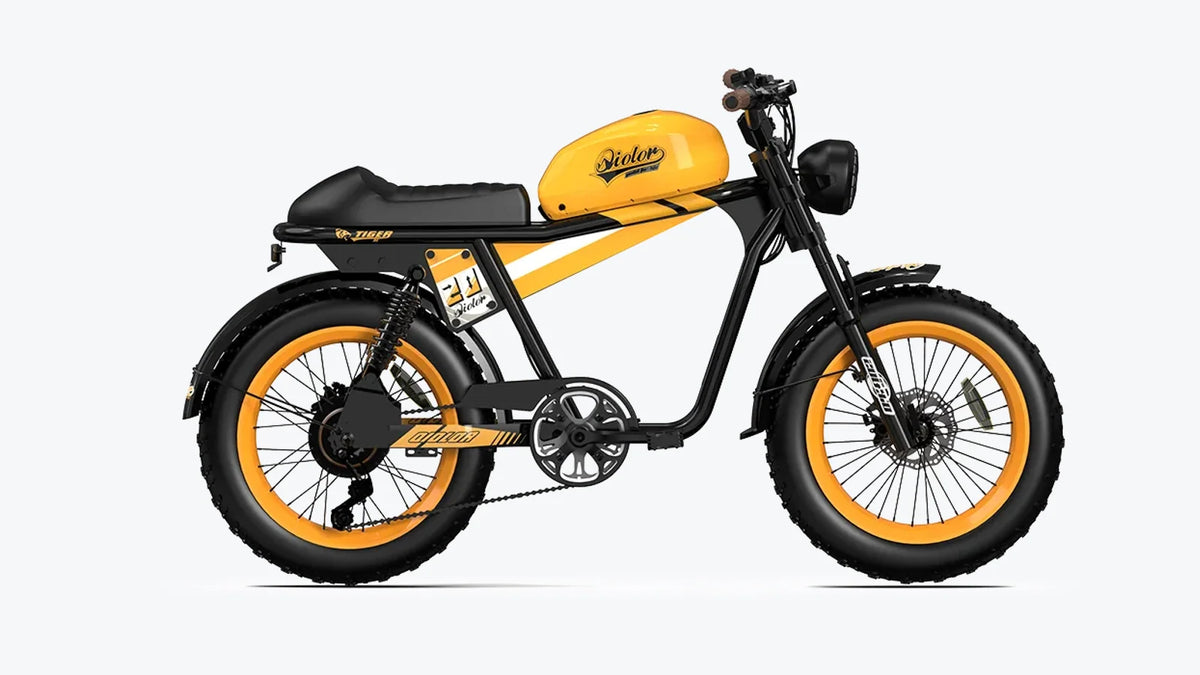
The best long-range e-bike is the one that covers your route with a sensible margin while still fitting how you ride, charge and store it. Start with battery watt-hours and the exact battery configuration. Then compare riding conditions. An advertised 80-mile pedal-assist result and an advertised 80-mile throttle result would describe very different demands.
For this Watt Wheelz shortlist, consider the Urtopia Carbon 1 Pro for a lighter pedal-assist setup, Carbon Fusion Pro for step-through access and a manufacturer-supported range extender, VTUVIA CMB 8-Speed for a mid-drive commuter, or Qiolor Tiger RE when a large standard battery matters more than low bike weight. None is a universal winner.
Research checked November 7, 2026. This is a specification-based buying guide, not a Watt Wheelz road test. Range figures below are manufacturer claims, not measured results from a common test. Products were active and orderable in the catalog when checked; that does not establish supplier stock or a dispatch date.
Four options, compared on the same questions
The table separates the standard battery from optional equipment. Watt-hours describe nominal stored energy, not guaranteed usable energy or distance. Calculated capacities use nominal voltage multiplied by amp-hours.
| Model | Nominal battery energy | Manufacturer range claim | Main decision |
|---|---|---|---|
| Urtopia Carbon 1 Pro | 352.8Wh standard | Up to 81 miles: 180-lb rider, ECO mode, flat roads, pedaling | Prioritize lower bike weight and active pedaling |
| Urtopia Carbon Fusion Pro | 529.2Wh standard; 882Wh with optional 352.8Wh extender | Up to 72.5 miles standard; up to 120 with extender | Choose an expandable step-through platform |
| VTUVIA CMB 8-Speed | 48V × 14.4Ah = 691.2Wh | Up to 80 miles pedal assist; up to 45 throttle-only | Consider a geared mid-drive commuter |
| Qiolor Tiger RE | 48V × 35Ah = 1,680Wh | Up to 130 miles, experimental PAS 1 result | Accept a heavier bike for a larger standard pack |
These headline miles are not a ranking of real-world endurance. The makers do not supply one shared test protocol. A lighter rider, more pedaling or lower assistance can change the result substantially. Browse the current long-range electric bike collection after deciding which configuration you actually need.
How we selected this shortlist
We compared current manufacturer documentation with Watt Wheelz product records, checked for an existing article covering the same cross-brand decision, and selected four distinct approaches to longer rides. The criteria are battery configuration, clarity of range claims, riding style, carrying burden and useful purchasing checks. We did not rank by the biggest advertised mileage.
We excluded draft-only products and a cargo model explicitly described as backordered. Orderable products with untracked inventory remain subject to supplier confirmation. We also omitted specifications where the maker's page disagrees with itself. This is a focused selection from the Watt Wheelz catalog, not a claim to have tested every long-range e-bike on the market.
Urtopia Carbon 1 Pro: for riders who want to pedal a lighter bike

The Carbon 1 Pro pairs a 352.8Wh removable battery with a current manufacturer-listed complete-bike weight of 41 lb. Its up-to-81-mile claim comes from ECO-mode riding with a 180-lb rider on flat roads. It is pedal-assist only, with no throttle, and Urtopia does not list an external battery option for this model.
That makes it worth considering if your plan involves contributing sustained pedal effort and moving the bike through daily life. The headline distance should not be used to plan an 81-mile hilly ride at high assistance. Check your actual frame size, carrying route and charging arrangements before placing it on a shortlist.
Choose it for: a lighter pedal-assist approach. Look elsewhere if: throttle riding or an officially supported range extender is central to your plan. The Urtopia model guide provides the broader brand context.
Urtopia Carbon Fusion Pro: for step-through access and battery expansion

The Carbon Fusion Pro has a 529.2Wh main battery and supports an optional 352.8Wh external pack, giving 882Wh combined nominal capacity. Urtopia advertises up to 72.5 miles with the standard battery and up to 120 with the extender. Its range note describes flat-road, average-traffic conditions but does not provide a complete rider-mass and assist-setting protocol.
The useful distinction is the expandable configuration, rather than the 120-mile headline. Decide whether you need the second battery now, confirm compatible hardware and inclusion in the quoted package, and compare the complete system cost. Do not assume the extender comes with the base bicycle.
Choose it for: step-through access with a manufacturer-supported expansion path. Look elsewhere if: you need a foldable bicycle or want the lowest possible carrying burden. The Fusion Pro here is not the dual-motor Fusion GT; do not mix their specifications.
VTUVIA CMB 8-Speed: for a mid-drive commuting shortlist
The CMB 8-Speed uses a 48V 14.4Ah battery, equivalent to 691.2Wh nominal, with a 500W nominal mid-drive motor. VTUVIA lists maximum ranges of 80 miles with pedal assist and 45 miles throttle-only. Those are separate claims, without a complete published common-test protocol for comparison with the other bikes.
This is the eight-speed model. Do not copy specifications or review conclusions from a CMB 10-Speed simply because the frame name looks similar. The current manufacturer's page also has conflicting peak-power and tire-size entries, so we have not used those figures to recommend it. We could not verify an exact eight-speed product photograph, so we have omitted it.
Choose it for: considering a mid-drive commuter with a clearly identified battery. Verify first: exact delivered drivetrain, fit and current component specifications. For routes dominated by climbing, use the separate e-bikes for hills guide as a starting point for drivetrain questions.
Qiolor Tiger RE: a larger standard battery with a weight trade-off

The Tiger RE lists a 48V 35Ah battery, equivalent to 1,680Wh nominal, and a bike weight of 98 lb. Its up-to-130-mile figure is an experimental PAS 1 pedal-assist result. The page does not specify all the rider, terrain and speed conditions required to reproduce it, and it is not a throttle-range promise.
The battery is materially larger than the other standard packs here, but carrying and storing the whole bicycle may be the deciding factor. A ground-floor parking area and an upstairs apartment create different practical choices. Check the actual doorway, parking space and loading method, not just whether the bike looks compact in a photo.
Choose it for: prioritizing a large standard energy capacity in a retro-style platform. Look elsewhere if: you must regularly lift the complete bicycle. Its charging-time entry is ambiguous, so confirm recharge requirements for the supplied battery and charger before planning back-to-back long days.
Why watt-hours are a better starting point than amp-hours
Amp-hours alone do not let you compare batteries at different voltages. Multiply nominal volts by amp-hours to calculate nominal watt-hours: 48V × 14.4Ah = 691.2Wh. Use the manufacturer's Wh rating when supplied and keep the exact battery configuration beside the number.
Capacity still does not tell you distance on its own. The bicycle, route, weather and rider determine how quickly energy is used. A larger pack can provide more energy without guaranteeing a greater distance than every smaller-battery bike under different conditions. Likewise, motor peak wattage is not a battery-capacity measurement.
This is why the Carbon 1 Pro's 81-mile claim cannot be treated as proof that its smaller pack outlasts the Fusion Pro's standard pack in a comparable ride. The comparison would require equivalent conditions and measurement. We have no such test here.
A route-energy worksheet you can use before buying
Write down your complete planned trip, including the return journey and reasonable detours. Note climbing, surface, expected cargo, preferred assistance, throttle use and access to a suitable charging location. These inputs matter more than picking a headline number that happens to exceed your commute.
- Trip distance: total miles between reliable charging opportunities.
- Energy assumption: watt-hours per mile for the scenario you want to examine.
- Planning fraction: the share of nominal capacity you are willing to allocate to the trip.
- Capacity calculation: trip miles × assumed Wh per mile ÷ planning fraction.
- Reality check: compare several assumptions and validate the chosen bike through shorter representative rides.
Illustrative example only: a 30-mile trip at an assumed 20Wh per mile uses 600Wh in the calculation. Allocating 80% of nominal capacity gives 600 ÷ 0.8 = 750Wh required nominal capacity in this scenario.
| Assumed energy use | Calculated trip energy | Capacity at an 80% planning fraction |
|---|---|---|
| 15Wh/mile | 450Wh | About 563Wh |
| 20Wh/mile | 600Wh | 750Wh |
| 25Wh/mile | 750Wh | About 938Wh |
These assumptions are not measured consumption for any bike in this guide. The 20% allowance is an editorial illustration, not a universal safety rule or guarantee. More demanding conditions, battery aging or a route with no practical exit may require different planning. The table shows how sensitive the choice is to assumptions; it does not certify that a particular battery will finish your trip.
Turn the worksheet into a practical shortlist
First remove bikes that fail your non-range requirements. You need a usable fit, a manageable parking and loading routine, and a permitted route. If carrying the bike is already impractical, extra battery capacity will not solve that problem. If rider and cargo loads matter, compare the relevant documented limits using the heavy-rider buying guide, then confirm the current model details.
Next compare standard versus expanded configurations under more than one energy assumption. A setup that only appears adequate under the most optimistic row deserves further investigation. A second battery may help, but compatibility, weight, mounting, charging and price all remain part of the decision.
Finally, test your plan gradually. Use shorter rides with a realistic load and similar hills, speed and assistance before depending on a long remote route. Record distance, conditions and battery indication. A percentage gauge is approximate; do not turn it into a precise laboratory consumption measurement. Have a workable return or pickup option while learning the bike.
Charging access can change the decision
A reliable charging stop may reduce how much distance must be covered on one charge. An outlet on a map is not enough: verify permission, access times, a suitable location and whether the stop is long enough for the supplied system. Do not build the plan around an unknown charger or an unconfirmed refill time.
Use only the supplied or manufacturer-recommended charger and follow the exact battery manual. The U.S. Consumer Product Safety Commission advises staying present while charging and not charging while asleep or away. Do not improvise a dual-battery connection or assume another brand's pack is compatible. Our battery-care guide is a starting point; the current manufacturer's instructions control model-specific requirements.
What to confirm before ordering
- The exact model, generation, frame size and drivetrain.
- Battery capacity included in the offer, plus any optional extender, mounting hardware and compatible charger.
- Current supplier availability and delivery estimate for your variant. An active listing is not proof of warehouse stock.
- Fit, total load limits, complete-bike weight and a safe loading/storage plan.
- Current local rules for the supplied configuration and intended route. A long range claim does not establish road or trail access.
- Warranty and replacement-battery support for that exact model.
If you are comparing two setups, contact Watt Wheelz with your round-trip distance, route, preferred riding style, rider/cargo needs and storage situation. Ask for the exact configuration and current availability before ordering. Start with the long-range collection once those requirements are clear.
Long-range e-bike questions
Which bike here has the largest standard battery?
The Qiolor Tiger RE's listed 48V 35Ah pack calculates to 1,680Wh nominal. That is a capacity comparison, not proof of the longest measured range. Its carrying weight and fit still matter.
Does the Fusion Pro include the 120-mile configuration?
The 120-mile claim requires the optional extender. Confirm the exact package: the standard 529.2Wh configuration and the combined 882Wh configuration are different purchases unless the offer explicitly includes both batteries.
Can I expect the advertised range while using only the throttle?
No. Pedal-assist claims rely on pedaling and their stated conditions. The CMB lists a separate throttle maximum; that figure is also a manufacturer claim, not a guarantee. The Carbon 1 Pro has no throttle.
Does a more powerful motor mean more range?
Motor output and battery energy are different quantities. Power may address acceleration or climbing needs, but range depends on energy consumed over the route. Compare battery configuration and riding demands separately.
Is a 20% reserve always enough?
No. It is only the example used in this worksheet. Route consequences, conditions, battery state and uncertainty should determine your planning allowance. A worked example cannot replace experience with the actual bike.
Should I buy the biggest battery I can find?
Only after considering weight, fit, storage, charging and the complete configuration. A bike that is difficult to use every day may be a poor choice even if its nominal capacity is large.
Can I add any second battery?
No. Use only a manufacturer-approved compatible system for the exact model. Do not assume a matching voltage or a connector that fits makes an accessory safe or compatible.
Are these bikes confirmed ready to ship?
They were active and orderable in Watt Wheelz's catalog when researched. Supplier inventory and dispatch timing were not independently established. Confirm your selected variant before relying on a delivery date.
Sources & Verification
Product specifications and range qualifications were checked against the current US manufacturer pages and corresponding Watt Wheelz listings on November 7, 2026. Capacity calculations and the route worksheet are explicitly labeled editorial arithmetic. No hands-on testing, guaranteed distance, certification-database verification or supplier-stock verification is claimed.
- Urtopia Carbon 1 Pro: battery, current weight and range-test note
- Urtopia Carbon Fusion Pro: standard and optional battery configurations
- VTUVIA CMB 8-Speed: battery and PAS/throttle claims
- Qiolor Tiger RE: battery, weight and PAS 1 qualification
- U.S. CPSC micromobility battery and charging guidance
- Bosch battery-safety guidance, used only for general context, not as a substitute for the manuals of the models above.