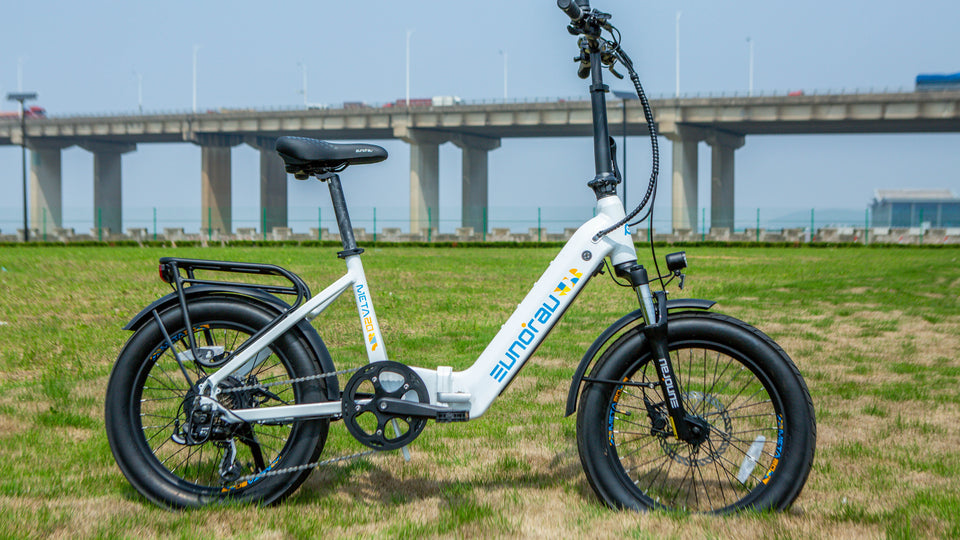
The EUNORAU META20 1.0 solves a storage problem: it folds. The META275 2.0 is a non-folding commuter with larger wheels, so it makes more sense if you can park a full-size bike and want that setup on the road. The motor rating and standard battery capacity are the same on the manufacturer comparison. Pick the shape that fits your day, not the one with the bigger number in its name.
This is the 20-inch META20 1.0 versus the 27.5-inch META275 2.0, not the similarly named earlier META275. Watt Wheelz sells both. We compared catalog and manufacturer records and did not conduct a road test for this article.
Where the two bikes are actually different
| Decision point | META20 1.0 | META275 2.0 |
|---|---|---|
| Storage format | Folding frame | Non-folding frame |
| Manufacturer tire size | 20 × 3.0 inches | 27.5 × 2.6 inches |
| Rated motor | 48 V, 500 W rear hub | 48 V, 500 W rear hub |
| Standard battery | 48 V, 15 Ah | 48 V, 15 Ah |
| Manufacturer-listed weight | 63.4 lb | 68.4 lb |
The folding bike still weighs over 60 lb at the manufacturer's stated figure. If the only way to park at work is to carry it up stairs, measure the route and check whether there is a lighter alternative. Folding changes the space the bike takes up, not how much it weighs. Printed weights can also exclude equipment; check the exact setup before making a lifting or transport decision.

When folding is the better trade
Pick the META20 first if you're trying to tuck a bike next to a desk, park it in a short storage bay or fit it in a vehicle without using an external carrier. Measure the cargo opening as well as the floor. The opening can be smaller than the interior once the seat hinges, trim and door are included. Check whether you can manage the folded mass without blocking an exit or lifting over a high sill.
The everyday question is whether you will actually fold it. If you have to unpack groceries, remove accessories or block a busy walkway each time, the folding frame may not help as much as it looks like it will. Think through the last few feet of your storage route: where you'll step, how much room you have to turn, and how you keep the folded bike secure. Our folding fit guide has a measurement checklist for cars, RVs and apartments.

When the full-size bike is the simpler choice
If your storage already fits a regular bike, the META275 2.0 removes the need to fold and unfold the frame. Its larger wheel format is worth considering for a route with repeated seams or rough pavement. That does not make it more comfortable in every case. Fit, tires, pressure and riding position all matter, so check the reach and test the handling if you can.
Think about parking before deciding. A ground-level garage or a bike room with space to roll in makes the non-folding frame easy to live with. A long bike that only fits positioned diagonally in an elevator is a different situation. Check the bike's dimensions against the actual doorway, not a guess based on wheel size.

Don't decide on advertised range alone
The standard 48 V, 15 Ah pack comes to 720 Wh at nominal voltage on either bike. EUNORAU lists an optional second 15 Ah pack for these platform versions. Its longer headline range is not a rule for every configuration or route. If your commute is manageable with the regular battery, an extender solves a problem you may not have. If you need one, verify the exact part, whether the listing includes it and whether any accessories interfere with installation.
Take your usual route, count the hills and stop-start sections, and identify a suitable charging location. If you are comparing this with a light city bike, include the storage and lifting tradeoff alongside the battery size. The Watt Wheelz urban mobility guide can help with that part of the decision.

A five-minute buying exercise
Write down two things you can't change: the smallest opening you need to get through and the roughest recurring segment of your ride. If the opening is the issue, compare the META20's physical fit with the alternatives before you do anything else. If the road is the issue and you can roll a full-size bike into storage, compare the META275 2.0 first. Only then shortlist the actual variants and the accessories you intend to buy.
Frequently asked questions
Does the META275 2.0 fold? No. The META20 is the folding model in this comparison.
Does the META20 have a smaller battery? Not in the manufacturer's standard comparison. It lists 48 V, 15 Ah on both.
Is the META20 easy to carry? Don't assume so. EUNORAU lists 63.4 lb. A folding frame has a smaller footprint but is not automatically easy to lift.
Does either bike include the extra battery? The manufacturer lists it as optional. Check the specific configuration you are ordering.
Is the META275 2.0 the same as the original META275? No. Use the exact 2.0 listing; don't import the original model's battery, tires or equipment into the comparison.
What should I ask before ordering? Ask for the delivered model revision, configured weight, exact dimensions if storage is tight, and the compatible accessory or extra battery part number if you plan to add one.
Sources & Verification
EUNORAU's META series comparison supplies the cross-model figures. Watt Wheelz checked its META20 1.0 and META275 2.0 listings on November 24, 2026. Photos come from our exact-model catalog galleries. For other EUNORAU layouts, see our EUNORAU buyer’s guide.