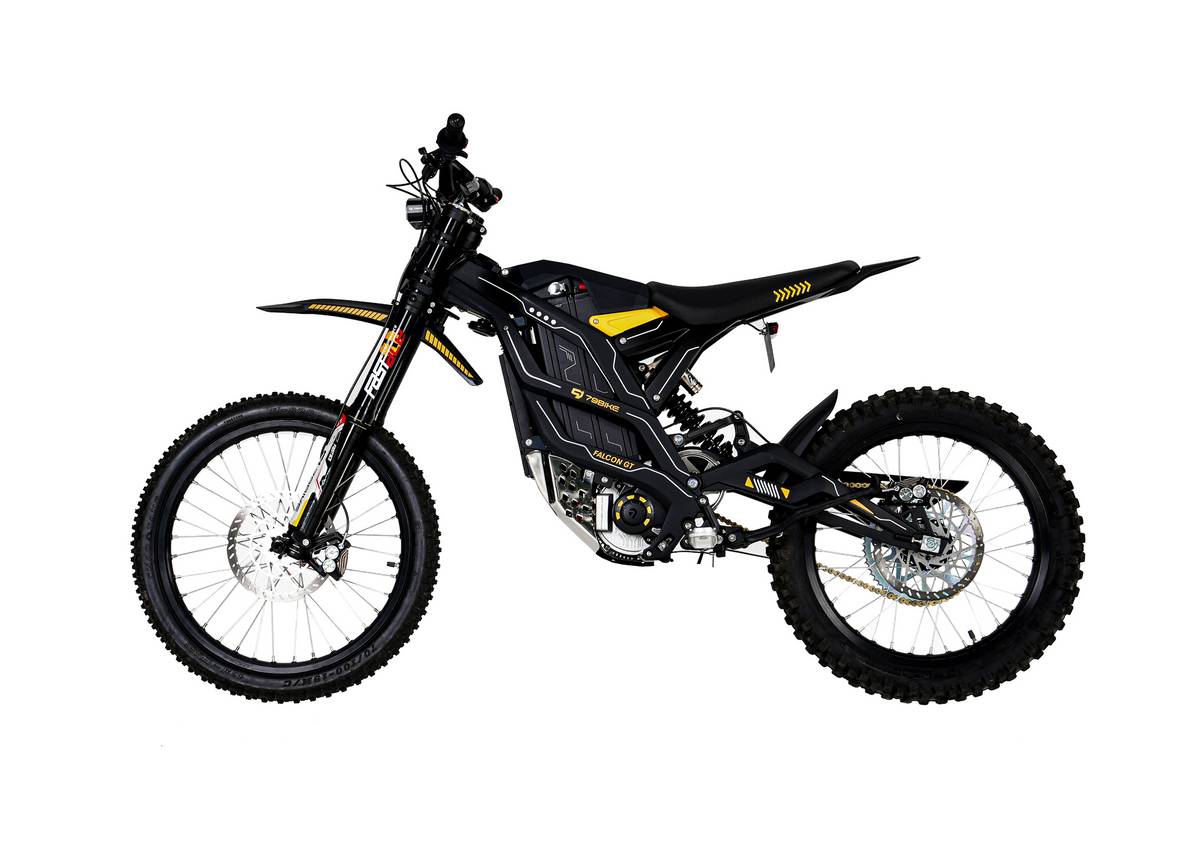
The 79Bike Falcon GT is built for riders who want substantially more output than a conventional electric bicycle and are specifically shopping in the high-performance off-road e-moto category. At WattWheelz, the current Falcon GT listing is priced at $4,799 before the model-specific $300 freight charge.
Quick verdict: the Falcon GT is one of 79Bike’s most aggressive performance offerings, pairing a 72V 40Ah Samsung battery with roughly 16–16.8 kW of published peak output, a claimed top speed up to 59 mph, 220 mm hydraulic brakes and long-travel suspension. Its appeal is straightforward: serious power, strong braking hardware and a relatively compact dirt-bike-style chassis. The tradeoff is that this is not the right choice for someone simply looking for a legal commuter e-bike, maximum aftermarket maturity or the easiest possible first high-output machine.
Important: the Falcon GT is marketed for off-road use and should not be treated as a conventional Class 1, Class 2 or Class 3 e-bike. Rules for high-output electric motorcycles and e-motos vary by state, county and city. Verify local laws, registration requirements and permitted riding areas before purchase or operation.

79Bike Falcon GT Specs at a Glance
| Specification | Falcon GT |
|---|---|
| Current WattWheelz price | $4,799 |
| Freight | +$300 |
| Published peak power | Approximately 16–16.8 kW* |
| Battery | 72V 40Ah Samsung 50S |
| Published top speed | Up to 59 mph |
| Published max range | Up to about 75 miles / 120 km under favorable low-speed conditions |
| Published torque | Up to 610 N·m |
| Weight | About 150–152 lb depending current published spec |
| Front / rear wheels | 19 in / 18 in |
| Front suspension | Fastace, 200 mm travel |
| Rear suspension travel | 85 mm |
| Brakes | 220 mm hydraulic discs |
| Charging | About 3–4 hours in current published materials |
| Use case | High-output off-road e-moto |
*79Bike and the current WattWheelz product materials use both 16.0 kW and 16.8 kW peak figures in different sections. Rather than pretending those numbers are identical, this review treats the current published specification as roughly 16–16.8 kW peak and flags the discrepancy for buyers.
What Makes the Falcon GT Different?
The Falcon GT is positioned above the more balanced Falcon Pro in the current 79Bike lineup. The main difference is not a single feature—it is the overall performance envelope. The GT combines a larger 72V 40Ah battery, higher published peak power, a 59 mph top-speed claim, up to 610 N·m of published torque and a suspension/brake package intended for aggressive off-road riding.
That makes it most relevant to buyers comparing electric dirt bikes and e-motos rather than shoppers cross-shopping conventional fat-tire or commuter e-bikes. If your primary goal is neighborhood riding, bike-path use or easy portability, the GT is probably more machine than you need. If your priority is acceleration, trail capability and higher-speed private-property riding, the GT becomes much more compelling.
See the current 79Bike Falcon GT product page for current pricing and configuration availability.

Power and Acceleration: The Main Reason to Buy It
Performance is the Falcon GT’s core selling point. Current 79Bike materials cite roughly 16 to 16.8 kW of peak motor output and up to 610 N·m of torque. On paper, that places it well beyond normal e-bike territory and into the high-output e-moto category.
Third-party ride impressions generally reinforce the idea that the GT feels fast and responsive relative to its size. Reviewers have praised its power-to-weight feel and playful trail manners. At the same time, at least one technical evaluation noted some throttle-response latency and an initial power surge in certain situations. That is an important distinction: maximum output is only one part of the riding experience; throttle calibration and predictability matter too, especially on loose terrain.
For experienced riders, that high-output character is likely a major advantage. For newer riders, it is a reason to approach the GT conservatively, use protective equipment and build familiarity gradually rather than treating the advertised speed as a target.
Battery, Range and Charging: What to Expect
The Falcon GT uses a 72V 40Ah Samsung 50S battery according to current published specifications. 79Bike advertises maximum range around 120 km, or roughly 75 miles, but that figure is tied to favorable low-speed testing conditions. The WattWheelz PDP also references approximately 80 miles at about 15 mph in one specification block.
That does not mean a buyer should expect 75–80 miles while repeatedly accelerating hard, climbing hills or riding near maximum speed. Real-world range can drop materially with rider weight, terrain, temperature, tire pressure, elevation change, speed and throttle use. For a machine like this, the advertised number is best understood as an upper-bound manufacturer test figure rather than a guaranteed trail range.
Published charging time varies slightly by section as well, with current materials generally stating about 3–4 hours. Buyers who plan long riding days should think about charging access and realistic riding style rather than focusing only on the maximum-range headline.
Suspension, Brakes and Trail Hardware
The Falcon GT uses a Fastace front fork with 200 mm of travel and adjustment for preload/rebound plus additional high- and low-speed tuning in current product materials. Rear suspension travel is listed at 85 mm. Braking is handled by 220 mm hydraulic discs front and rear.
Third-party testers have been especially positive about the braking package, describing strong stopping power and good modulation. That matters on a roughly 150-plus-pound machine capable of much higher speeds than a typical e-bike.
The suspension receives more mixed feedback. Some reviewers like the plush, confidence-building trail feel; others have said the setup can feel soft under harder impacts or would benefit from a taller front-end feel. Rider weight, terrain and setup will strongly influence that impression. The GT should therefore be viewed as a capable factory package, not as proof that every rider will love the stock suspension settings out of the box.

Falcon GT vs Falcon Pro: Which 79Bike Should You Buy?
The Falcon GT and Falcon Pro make sense for different buyers. The GT is the maximum-performance choice; the Pro is the more balanced choice for riders who still want a fast 72V platform without stepping all the way into the GT’s power and price tier.
| Buyer priority | Better fit | Why |
|---|---|---|
| Maximum published power | Falcon GT | Roughly 16–16.8 kW peak vs a lower-output Pro setup |
| Highest published top speed | Falcon GT | Up to 59 mph |
| More balanced performance/value | Falcon Pro | Strong performance without paying for the GT’s maximum-output package |
| Larger battery | Falcon GT | 72V 40Ah vs the Pro’s smaller capacity |
| Experienced rider seeking flagship 79Bike | Falcon GT | Higher ceiling for off-road performance |
Read our full 79Bike Falcon Pro review if you are deciding between the two. You can also compare the wider lineup in our Best 79Bike Electric Bikes of 2026 guide.
Falcon GT Pros
- Very high output: approximately 16–16.8 kW peak in current published materials.
- Large 72V 40Ah Samsung battery: useful capacity for a high-output platform.
- Strong brake hardware: 220 mm hydraulic discs and positive third-party braking feedback.
- Adjustable long-travel front suspension: built around off-road use rather than urban commuting.
- Useful rider features: NFC, multifunction display, USB-C, lighting, turn signals and safety sensors are listed on the current PDP.
- Compact performance package: reviewers often describe the GT as agile relative to its output and weight.
Falcon GT Cons and Tradeoffs
- Not a conventional street-legal e-bike: buyers need to understand local e-moto rules and permitted riding areas.
- $300 freight charge: factor this into delivered cost rather than assuming free shipping.
- Published spec inconsistencies: current materials vary between 16 kW and 16.8 kW, roughly 150 and 152 lb, and 3 vs 3–4 hour charging claims.
- Range claims require context: advertised maximum range comes from favorable low-speed conditions and will not represent every rider’s real-world use.
- Some reviewer-reported setup concerns: throttle response, front-end ergonomics and suspension feel have drawn mixed comments.
- Smaller ecosystem than the most established e-moto platforms: buyers who heavily prioritize aftermarket breadth may want to compare support and parts availability before deciding.
Who the Falcon GT Is Best For
The Falcon GT makes the most sense for an experienced or performance-oriented rider who specifically wants a high-output off-road electric dirt bike and values power, braking and a large battery more than light weight, bicycle-class legality or maximum portability.
It is especially compelling if you already know that the Falcon Pro is not quite enough for your desired performance level. The GT gives you the more extreme end of the 79Bike range without forcing you to compare the product as though it were a normal commuter e-bike.
If you are still unsure which format fits your riding style, browse the 79Bike collection, compare our broader Dirt E-Bikes collection, or use the Find My E-Bike tool for a more guided path.

Who Should Skip the Falcon GT?
You should probably skip the Falcon GT if your priorities are legal bike-lane commuting, carrying the bike upstairs, transporting it on a conventional bicycle rack, maximizing aftermarket compatibility, or getting the lowest-cost entry point into electric riding. It is also not the ideal first choice for someone who has never ridden a high-output e-moto and has no safe place to learn the machine.
In those cases, a lower-output e-bike or a more balanced model may deliver a better ownership experience even if its spec sheet looks less dramatic.
Final Verdict: Is the 79Bike Falcon GT Worth It?
For the right rider, yes. The 79Bike Falcon GT offers an unusually aggressive combination of published peak output, 72V 40Ah battery capacity, strong braking hardware and off-road-focused chassis components at its current $4,799 price point. Its value proposition is strongest when judged against other high-performance e-motos—not ordinary commuter e-bikes.
The main reasons to hesitate are equally clear: a $300 freight charge, high-output legal/use restrictions, some mixed third-party feedback around throttle feel and suspension/ergonomics, and specification inconsistencies that buyers deserve to see disclosed rather than hidden.
Our recommendation is to buy the GT when you specifically want the flagship-performance side of the 79Bike lineup. If you care more about balance than maximum output, compare it directly with the Falcon Pro before making the decision.
Frequently Asked Questions
How fast is the 79Bike Falcon GT?
79Bike currently publishes a maximum speed of up to 59 mph. Actual speed depends on rider weight, terrain, battery state, conditions and setup. Always ride within local laws and appropriate off-road conditions.
Is the Falcon GT 16 kW or 16.8 kW?
Current 79Bike and WattWheelz materials contain both figures. Some sections list 16,000W / 16 kW while detailed specifications and comparison materials list 16.8 kW. We therefore describe the current published peak figure as roughly 16–16.8 kW rather than presenting one number as universally definitive.
What battery does the Falcon GT use?
Current specifications list a 72V 40Ah Samsung 50S battery.
What is the real-world range?
79Bike advertises up to roughly 75 miles / 120 km under favorable low-speed conditions. Aggressive riding, higher speeds, hills, rider weight and temperature can reduce real-world range substantially.
Is the Falcon GT street legal?
The current WattWheelz product page identifies it for off-road use and not as a conventional street-legal e-bike. Laws vary by location, so confirm your state and local requirements before riding on public roads or paths.
Does the Falcon GT have free shipping?
No. The current WattWheelz offer includes a $300 freight charge for the Falcon GT.
Should I buy the Falcon GT or Falcon Pro?
Choose the GT if maximum 79Bike performance, the larger battery and higher published output are your priorities. Choose the Falcon Pro if you want a more balanced performance/value package and do not need the GT’s higher ceiling.
Sources & Verification
This review was reconciled against the current WattWheelz Falcon GT product listing, current 79Bike Falcon GT product/specification materials, 79Bike model-comparison information, and third-party ride/review coverage. Published specifications can change, so verify the live product page before ordering. Where current first-party sources conflict—most notably the 16.0 kW vs 16.8 kW peak-power figure—we disclose the conflict rather than silently choosing one value.